What to Expect During Steve Mnuchin’s Confirmation Hearing
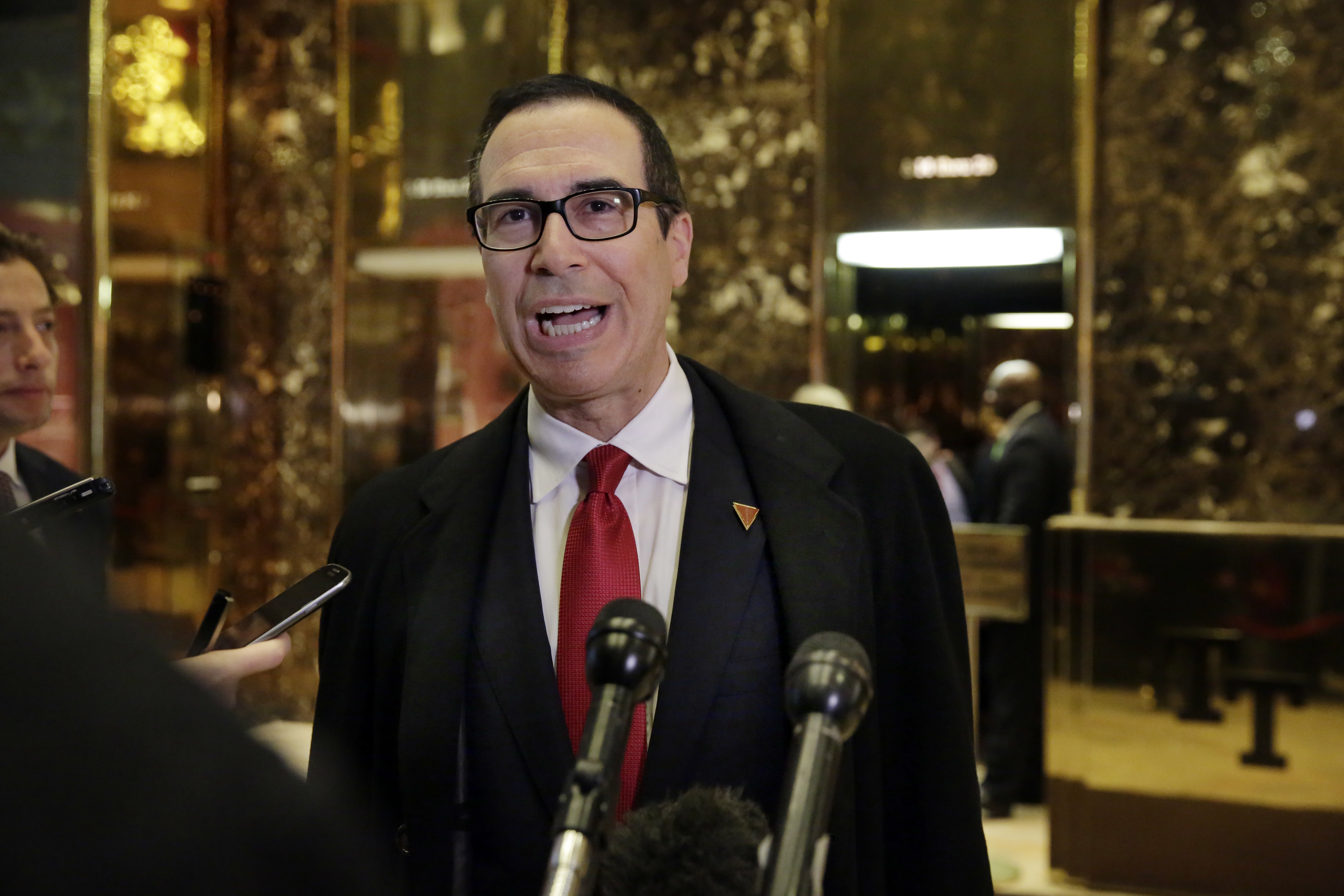
“Will Steve Mnuchin Bomb His Confirmation Hearing?,” asked one of the latest headlines in Vanity Fair. Clearly, many Democrats are eager to see the spectacle of Mnuchin’s confirmation hearing for Treasury secretary.
On Thursday, the former Goldman Sachs partner will testify before the Senate Finance Committee, and although, Republicans are expected to confirm President-elect Trump’s nominee, Democrats aren’t going down without a fight. They will most likely bring up sore points in Mnuchin’s career, especially the numerous reports of misconduct when he was in charge of OneWest.
This makes sense though, especially since the Democratic Party needs to win over working-class voters, who were attracted to Trump’s populist appeal, and rebuild their economic message before the 2018 midterm elections. And, of course, these confirmation hearings are always interesting to see if there are any early 2020 presidential possibilities.
It will be intriguing to learn whether any more information will come out about Mnuchin’s policy ideas for the Treasury Department, or whether it will largely resemble a carnival sideshow?
“They [confirmation hearings] too often become…game shows,” said Pete Sepp, president of the National Taxpayers Union, in a Wednesday press call.
“They don’t always get to the very important issues that could be amplified in the hearing process, to better understand how members of Congress and the executive branch will cooperate,” he said.
For him and David Williams, president of the Taxpayers Protection Alliance, one of those important issues is tax policy.
“The good news is Mnuchin is on record saying tax reform is one of his top priorities,” Williams said. “If people aren’t going to read all of War and Peace [by Leo Tolstoy], they aren’t going to read the whole tax code. This is a breath of fresh air for frustrated taxpayers.”
Republicans are also eager for tax reform, and while Mnuchin has said he would like to see it done, Congress will ultimately have to make it happen. Mnuchin was involved in writing Trump’s tax plan during the campaign, so it’s likely he will be involved in drafting legislation.
If confirmed for the position, he would have power over some regulations within the tax code. For example, he could roll back inversions, a controversial regulation enacted under President Barack Obama’s administration that sought to stop companies from avoiding U.S. taxes by moving their legal domicile to a low-tax country. Even that would be difficult to do because it was a rule issued by the Treasury and Internal Revenue Services (IRS), and the IRS is pretty independent even though it is technically housed within the department.
Trump and Mnuchin could seek more influence over the IRS since the president-elect will choose the next head of the federal agency. And they could end the limited oversight of regulations issued by the IRS that makes it so independent.
Although Mnuchin can’t exercise power over specific parts of the tax code, he has indicated he supports several measures in the House GOP’s plan for tax reform. The Trump administration, House Speaker Paul Ryan, and House Ways and Means Committee Chairman Kevin Brady want to cut the corporate tax rate, but they disagree by how much. The House GOP plan has it at a 20 percent tax rate, while Trump and Mnuchin want a 15 percent rate.
Will Senate Democrats ask about Mnuchin’s tax reform plans? It remains to be seen.
DODD-FRANK
Another possible policy area that could come up during the hearing is Mnuchin’s plan to roll back parts of Dodd-Frank, the financial regulatory law passed after the financial crisis.
It’s unknown what specific parts he wants to do away with, so it can be expected that a senator might ask him.
Although he can’t repeal Dodd-Frank (only Congress can), the law does give the Treasury secretary some authority over the financial system, as head of the Financial Stability Oversight Council (FSOC). This council contains all the heads of the top financial regulators and is meant to deal with systemic financial risks. So Mnuchin could have a lot of influence over the agenda of the FSOC.
For example, the council is responsible for identifying and designating systemically important financial institutions — the ones who could trigger a financial crisis, or the ones that are “too big to fail.” Mnuchin could have the FSOC staff look at non-bank threats that would upend the system. The Obama administration has been aggressive in naming such threats and has faced significant criticism for pointing to companies like MetLife as systemically important. But he can’t really tell the other FSOC members what to do in their own respective agencies. The Federal Reserve, U.S. Securities and Exchange Commission, among the other members, are independent, and he can’t dictate their policy. But he sure can tell Trump who to put in charge of those agencies and influence them that way.
FREDDIE AND FANNIE
Soon after Mnuchin was announced as Trump’s Treasury pick, he said Fannie Mae and Freddie Mac should leave government control and the president-elect’s administration “will get it done reasonably fast.”
“We will make sure that when they are restructured, they are absolutely safe and don’t get taken over again,” he told Fox Business. “But we’ve got to get them out of government control.”
This idea isn’t anything new. The battle over the future of mortgage companies has been discussed in Congress since they were bailed out in 2008 for $187.5 billion. Since then, Fannie and Freddie have been in conservatorship, controlled by the federal government. Fannie and Freddie have fully paid back all money owed to taxpayers, but the Treasury has continued to seize all profits, not allowing the mortgage giants to accumulate capital.
Mnuchin appears set on a path to end the seizure of profits. More will likely be learned during the hearings.
STRONG-DOLLAR POLICY
Expect to also hear Mnuchin’s comments about the strong-dollar policy. It’s been a mantra of Treasury secretaries since the mid-1990s. Usually, Republican and Democratic administrations have maintained a policy of backing a strong U.S. currency, speaking neutrally about it, for fear of upsetting the financial markets. But Trump went and changed that.
“Our dollar is too strong,” Trump told The Wall Street Journal last week. “And our companies can’t compete with [China] now because our currency is too strong. And it’s killing us.”
Will Mnuchin echo Trump’s sentiments or will he maintain a strong-dollar policy tradition? The markets await his answer.
These are some of the policy issues conservative and liberal researchers are waiting to hear about to see how it could impact the economy.
“It’s incredibly troubling that someone who ran on draining the swamp and fighting for everyday Americans is putting someone, who has not demonstrated any interest or ability to fight for Americans, in charge of the U.S. economy,” said Sarah Edelman, director of housing policy at the Center for American Progress, a liberal policy institute.
Mnuchin’s confirmation hearing begins at 10 a.m.