inside sources print logo
Get up-to-date news in your inbox

FCC Chairman Prefers Net Neutrality Legislation Over Agency Rules
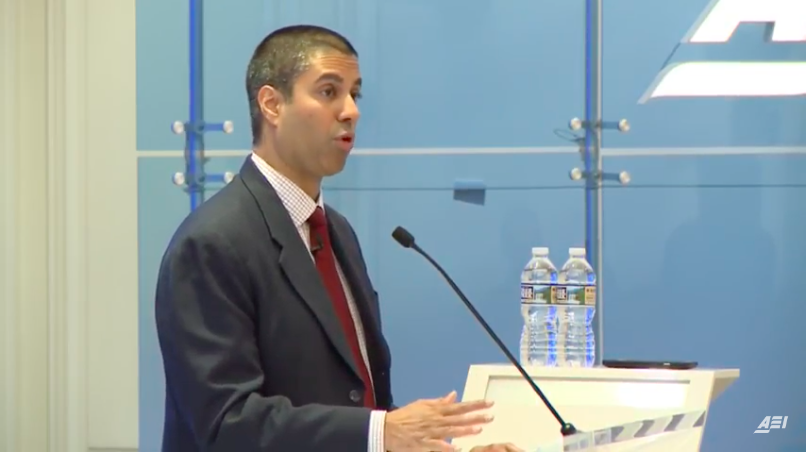
President Donald Trump’s Republican choice to lead the Federal Communications Commission said legislation from Congress making net neutrality rules law would be preferable to agency rules the FCC is working to repeal.

“I believe that legislation would provide greater certainty to consumers and companies alike,” FCC Chairman Ajit Pai told Congress Tuesday.

The comments come in the midst of Pai’s plan to dramatically scale back and possibly eliminate the Obama-era rules altogether. That plan has received more than 10 million public comments as it has sparked coverage on major cable shows and reignited public debate not only about open internet regulations but also conspiracies about hundreds of thousands of fake comments and cyberattacks all aimed at swaying the agency’s decision.

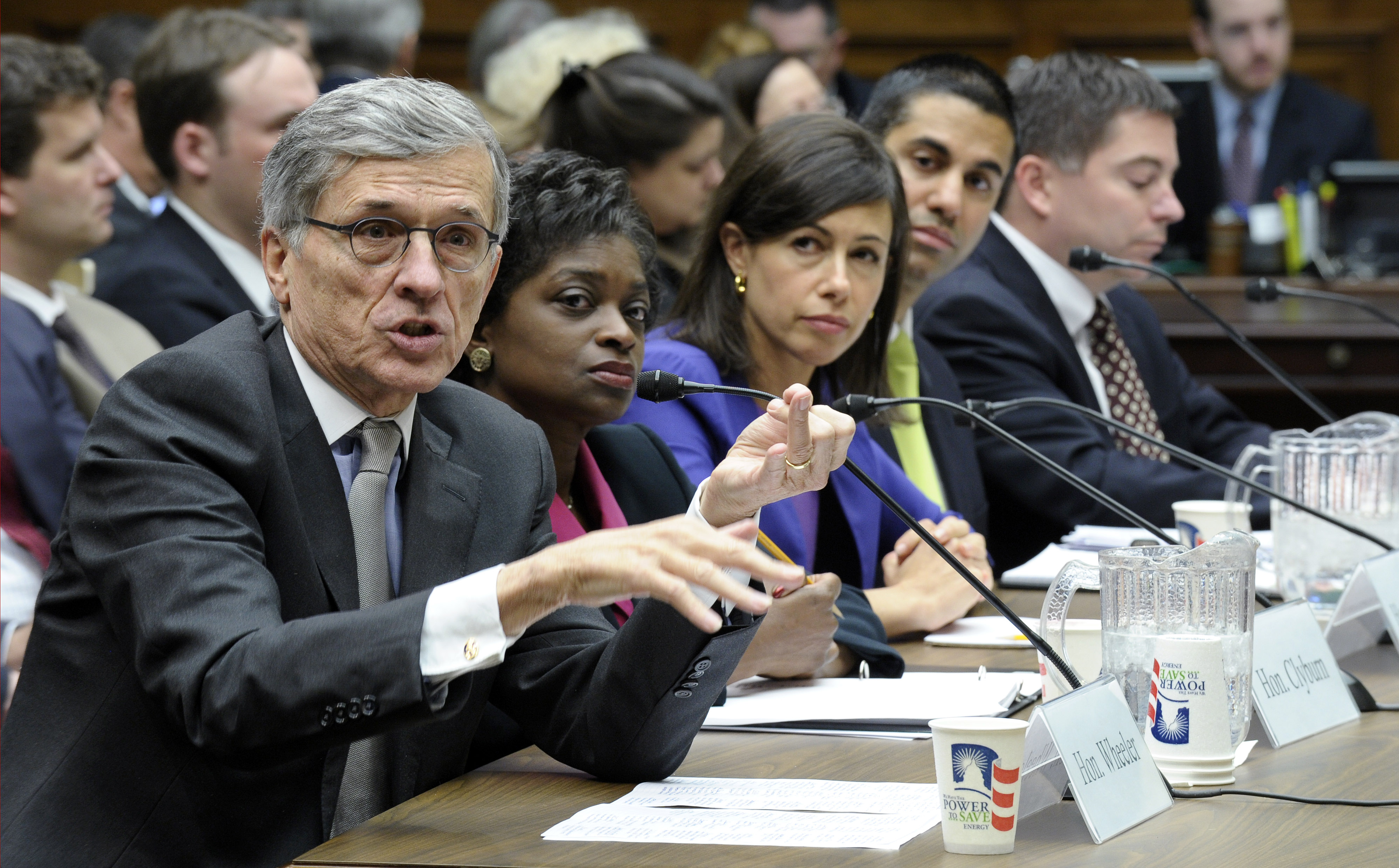
Net neutrality dominated a Tuesday hearing before a House subcommittee scheduled to discuss reauthorizing the FCC’s mission with its commissioners.

“I fully support legislation,” Republican Commissioner Michael O’Rielly agreed. “It’s the only way we’re going to get lasting peace on the issue.”

Commissioner Mignon Clyburn — currently the only Democrat and net neutrality supporter on the FCC — disagreed.

“I believe we already have certainty,” Clyburn said. “Title II is part of a congressional creation. Title II has been upheld by the courts,” she said referring to the section of the Communications Act the FCC used to classify internet service providers as public utilities in 2015. Title II is the strict regulatory authority it used to justify enforcing rules against web traffic throttling, blocking, and paid prioritization.

Undoing Title II, which Republicans believe undermines investment in broadband network growth, is the primary focus of Pai’s repeal. And despite Clyburn’s support for the rules she voted for during the previous administration, she wouldn’t rule out supporting an amendment to Title II in the context of broadband.

“I will reserve judgement on that,” she told lawmakers. “I will favor anything that will improve and enhance our ability to connect America.”

While Republicans including Senate Commerce, Science and Transportation Committee Chairman John Thune have been working on net neutrality legislation since before the FCC passed its rules in 2015, Democrats have until recently been unwilling to come to the table. Congressional Democrats have instead supported former President Barack Obama and former FCC Chairman Tom Wheeler’s Title II approach.

Title II is heavy-handed regulatation originally designed to break up telephone monopolies in the 1930s, and can potentially subject broadband providers like Comcast and AT&T to regulations like price setting (though the FCC under Wheeler expressly forbore from many of those regulations when it passed the rules).

There’s unanimous consent on Capitol Hill for rules against blocking, throttling, and paid prioritization, and providers themselves largely agree. Thune predicted in January that the threat of a Republican FCC repealing the Obama-era rules may be the only thing capable of bringing Democrats on board with legislation minus Title II.

Now Pai’s plan has made that threat a reality, and according to Oregon Republican Rep. Greg Walden — who chairs the full committee charged with overseeing the FCC — the House will begin seriously considering net neutrality legislation in the fall, with an initial hearing scheduled for September.

“I’m announcing this morning that I’m convening a full Energy and Commerce Committee hearing entitled ‘ground rules for the internet ecosystem’ for Thursday Sept. 7 2017,” Walden said.

The congressman added he will begin sending invitations to leading tech companies including Facebook, Alphabet (parent company of Google), Amazon, and Netflix. They’ll be joined by some of the largest broadband providers in U.S. including Comcast, AT&T, Verizon, and Charter Communications, rounding out the other side of the debate.

“It is essential that we hear directly from the country’s top internet and edge provider leaders who frequently speak out publicly about rules of the internet,” Walden said. “It’s time for Congress to legislate the rules of the internet, and stop the ping pong game of regulation and litigation.”

Shortly after Tuesday’s hearing AT&T signaled its intention to participate and support net neutrality legislation.

“The FCC appears free to oscillate back and forth between these two fundamentally different regulatory regimes, based only on which party happens to be in the majority,” said Tim McKone, AT&T’s executive vice president of federal relations. “It is the job of Congress, not expert agencies, to resolve this kind of a fundamental question regarding the appropriate policy for regulation of the internet.”

Democrats including Connecticut Sen. Richard Blumenthal and New York Rep. Joe Crowley have also begun to publicly signal willingness to support legislation.

“If they won’t join with us in opposing the [FCC] order, then hopefully they’ll side with us in legislation,” Blumenthal said of Republicans in July. That same day Crowley said it was time for Congress to “update our laws to make #netneutrality permanent” in a Facebook post.

Some leaders of major edge providers are also coming onboard. The same day Blumenthal and Crowley mentioned legislation, Facebook CEO Mark Zuckerberg said the social media giant is “open to working with members of Congress and anyone else on laws to protect net neutrality.”

The Internet Association, a trade group representing the biggest companies and net neutrality supporters in Silicon Valley including Amazon, Google, Netflix, Reddit, Twitter, and others, told the FCC in a recent filing it’s “open to alternative legal bases for the rules, either via legislative action codifying the existing net neutrality rules or via sound legal theories offered by the Commission that will satisfy judicial review.”

Follow Giuseppe on Twitter

Subscribe for the Latest From InsideSources Every Morning

Congress Tells New FCC Head to Abandon Set-Top Box Reform

Republicans in Congress asked the new head of the Federal Communications Commission Wednesday to abandon a proposal to make cable providers offer content on apps instead of forcing subscribers to rent set-top boxes.

The proposal is aimed at giving cable and satellite TV subscribers an alternative to paying monthly fees to rent boxes from Comcast, Verizon and others. Those fees cost the average American household $231 annually, according to congressional Democrats. It would also allow third parties like Google to build and sell set-top boxes, on which subscribers could download apps from their TV provider and view content.

Republicans on the House Energy and Commerce Committee have opposed the rules since introduced by former Democratic Chairman Tom Wheeler last year. They asked his newly named successor, Republican Commissioner Ajit Pai, to close the proceeding Wednesday.

“We are writing to ask that you close the docket on the set-top box proceeding,” Chairman Greg Walden wrote to Pai, “and signal clearly to consumers, content producers, consumer electronics manufacturers, and video programming distributors that the commission’s consideration of its set-top box proposal is at an end.”

The letter was signed by Tennessee Rep. Marsha Blackburn, who chairs the Subcommittee on Communications and Technology that frequently oversees the FCC, and echoes arguments they lobbed at Wheeler on the plan’s potential to harm copyright, advertisers and minority programmers.

“Cable, satellite and over-the-top video services are innovating, bringing their services to apps on new platforms, and responding to consumer demand,” the letter reads. “We should be fostering that kind of consumer-focused innovation, not mandating a one-size-fits-all ‘innovation.'”

The agency scheduled a vote on the plan last year, but Wheeler failed to get the votes necessary for passage from one of his two Democratic colleagues. Former Commissioner Jessica Rosenworcel dissented over a proposal to establish a licensing body at the FCC to review contracts between pay-TV providers and the third-party device manufacturers they would have to offer their apps on.

Pai and his Republican colleague Commissioner Michael O’Rielly agreed. Last year Pai said the two-year delay on the plan’s implementation will leave it lagging far behind technology “moving away from set-top boxes” in favor of video streaming services like Netflix, Hulu, and Amazon Prime. A proposal focusing on hardware, he said, could slow the app-based direction of the industry.

“Our goal should not be to unlock the box; it should be to eliminate the box,” Pai said. “If you are a cable customer and you don’t want to have a set-top box, you shouldn’t be required to have one. This goal is technically feasible, and it reflects most consumers’ preferences — including my own.”

Pai said previous FCC regulation in the set-top box market shaped the current system, which costs Americans $20 billion a year in rental fees and $500 million in kilowatt hours in energy consumption, “enough to power all the homes in Washington, D.C. for three months.”

He added multichannel video programming distributors and electronics manufacturers are unlikely to agree on video formats, specifications and standards that would make third-party boxes workable.

“The odds are probably better that Mark Zuckerberg will agree to Kanye West’s request for $1 billion,” Pai joked at the time.

In response to Wednesday’s letter, pro-net neutrality group Public Knowledge asked Pai to support reform.

“Despite the FCC’s recent efforts on this issue, the law has not been enforced and consumers continue to be burdened by a multi-billion dollar set-top box ripoff,” PK Senior Counsel John Bergmayer said. “Chairman Pai should continue the FCC’s work to bring consumers relief in this matter.”

Television provider heavyweights like Comcast and Verizon have begun offering limited content on mobile applications. Last year, DirecTV launched the most competitive offering to date, DirecTV Now, which offers a limited time entry price of $35 monthly for 100 live-streamed channels aimed specifically at cord-cutters.

Follow Giuseppe on Twitter

Subscribe for the Latest From InsideSources Every Morning

FCC Democrat Sides with Republican Commissioners on Set-Top Box Proposal

One of the Federal Communications Commission’s three Democratic commissioners broke ranks from the majority Tuesday to side with its two Republican commissioners on possibly the hottest issue pending before the agency — set-top boxes.

During a congressional oversight hearing Tuesday FCC Commissioner Jessica Rosenworcel agreed there are flaws in Chairman Tom Wheeler’s proposal to mandate pay-TV providers make their content available on third-party set-top boxes.

“I’ll make it easy — yes,” Rosenworcel said in response to a yes or no question from Tennessee Republican Rep. Marsha Blackburn about whether the commissioners thought the initial proposal was flawed.

Though such bipartisan consensus has become increasingly rare at the FCC, Rosenworcel wasn’t the only Democrat to imply there are flaws with the pitch. Commissioner Mignon Clyburn declined to answer the question, while Wheeler said “everything is designed to seek improvement.”

“That’s what we’re trying to do right now,” Wheeler said when asked about taking a different approach from the original Notice of Proposed Rulemaking. “We’re working with the industry.”

All four fellow commissioners agreed on the need for another approach, and that the one recently pitched by Comcast, DirecTV, and the National Cable and Telecommunications Association to offer their content on apps shows promise.

“One page. It’s not a proposal, it’s a press release,” Wheeler said. “The great thing is that it lowered the temperature and we can talk together.”

While Wheeler and Clyburn disagreed the original plan rendered copyright worthless, Rosenworcel again diverged from her colleagues, and said after a meeting with the copyright office she agreed the original plan puts the content that pay-TV providers pay for at risk of manipulation or theft on third-party devices.

“I think that more work is necessary on our part,” Rosenworcel said.

Since the proposal was announced earlier this year content, providers have expressed concern the plan will make their property vulnerable to pirating both nationally and internationally.

“I think that you’ve got a long way to go on set-top boxes,” Blackburn said.

The bipartisan atmosphere didn’t last long. Questions aimed at Pai concerning his ongoing investigation into Lifeline fraud led to bickering between Republicans and Democrats on the Communications and Technology Subcommittee and at the witness table.

While Pai said he believes he’s “uncovered potential fraud,” California Democrat Rep. Anna Eshoo pressed Pai on whether he had any evidence, and warned the commissioner to “be very careful” in making such allegations.

“Just answer me yes or no, have you uncovered any fraud so far?” Eshoo asked.

“To date, I have not reached that conclusion,” Pai conceded.

Pai’s investigation into Lifeline has focused on providers overriding a database meant to flag and prevent multiple enrollments, a practice the agency has fined numerous providers over including the largest in history recently levied against Total Call Mobile.

As was the case with Total Call Mobile, Pai suspects the overrides — which presently account for 48 percent of enrollments — represent the latest trend in provider fraud, while Democrats allege the majority are legitimate overrides for independent subscribers sharing an address like a homeless shelter.

Wheeler said there are 2.2 million Lifeline subscribers today that live in 890,000 multiple resident addresses, and according to the U.S. Census Bureau, 20 to 50 percent of American households are “doubled up” households, putting the 16 percent of Lifeline subscribers on the low end.

“So you’re going to say there is no fraud then? Yes or no?” subcommittee chairman and Oregon Republican Rep. Greg Walden asked, coming to Pai’s defense.

“I’m going to say to you sir that we are vigilantly working, and the reason that we know this is because we have been out making these kinds of investigations,” Wheeler said. “As is the case with most of Commissioner Pai’s so-called statistics, he’s reading from yesterday’s newspaper. These things were shut down in 2015.”

Eshoo said the Lifeline fraud the FCC has taken action on was perpetrated by providers, not subscribers. Pennsylvania Democratic Rep. Michael Doyle said that while the program is assuredly not free of fraud, it’s likely “committed by companies, not the poor.”

Wheeler added his FCC inherited the problem of “the fox guarding the henhouse” from the Bush administration’s FCC, and the National Eligibility Verifier system included in his recent Lifeline expansion adding broadband internet will correct the issue when it goes live in 2019.

Follow Giuseppe on Twitter

Democrats Accuse GOP of ‘Hurting’ Poor Americans With ‘Obama Phone’ Budget Cap

House Republicans advanced a bill Tuesday to cap the Federal Communications Commission’s recently expanded Lifeline budget, a move they say will stymie fraud and abuse in the program, and one Democrats say will harm poor Americans.

Lawmakers on the Communications and Technology Subcommittee held markup on the Controlling the Unchecked and Reckless Ballooning of Lifeline Act of 2016 (CURB Act) Tuesday afternoon, voting 17-11 to approve changes to the bill. The CURB Act caps Lifeline spending at $1.5 billion, down from the FCC’s recently expanded $2.25 billion.

Originally put in place to provide low-income Americans with a monthly subsidy to pay for phone service, the FCC voted along partisan lines in March to expand its reach to include Internet, at the same time boosting its budget with a mechanism for commissioners to review when it reaches a certain threshold, but doesn’t put a hard cap in place.

Republicans on the commission and in Congress say the increased budget will expand the potential for fraud that was at one time endemic to the program.

“All we’re asking for is a dose of fiscal discipline,” Oregon Republican and subcommittee Chairman Greg Walden said. “If there’s a budget in place, the FCC will be forced to undergo a more serious examination of the problems plaguing this system.”

Democrats on the committee accused Republicans of trying to deprive low-income Americans of vital services needed to participate in a 21st century economy, and inhibiting their access to life-saving services like 9-1-1.

“Why are we hurting these people?” California Rep. Anna Eshoo, the subcommittee’s ranking Democrat, said during markup Tuesday, describing the legislation as “hurtful” and calling on her colleagues across the aisle to be “better than this.”

“You’re going to be taking away 9-1-1 services from them,” she continued. “Who wants to answer for that?”

Walden said he was offended Democrats would accuse Republicans of intentionally hurting the poor.

“I’ve done plenty for the poor,” Walden said. “I think the people paying the bill deserve protection too. Just like I think those that need help most among us need support. But I’m willing to do both.”

Walden and Georgia Republican Rep. Austin Scott, the bill’s author, say the legislation is aimed at protecting American consumers, who pay for Lifeline via fees on their monthly phone bills.

Louisiana Rep. Steve Scalise said those people include struggling consumers like single parents ineligible for the subsidy, who face increasing Universal Service Fees to pay for government proposals like the Lifeline expansion.

Shortly after Lifeline was expanded to include wireless service, the program’s budget rose more than 25 percent per year from $821 million in 2008 to $2.1 billion in 2012.

The rise in cost came in part from rampant fraud and abuse from consumers to wireless providers. The FCC reported 41 percent of the program’s more than six million subscribers in 2012 failed to provide eligibility documentation, with many subscribers enrolling multiple times across different carriers with falsified information to get a free cellphone along with the subsidy.

At the same time, several small wireless providers were caught enrolling the same customers multiple times for profit, prompting the FCC to implement reforms in 2012 including a database to prevent duplicate enrollees and fining cheating providers $96 million for negligence and fraud. The changes prompted a budget reduction in 2014 to its current $1.6 million.

The committee voted down a Democratic amendment to delay the cap until the FCC reports on the effect of a smaller budget, but approved an amendment from Kentucky Democrat Rep. John Yarmuth prompting the Government Accountability Office to study whether the cap is effective in reducing fraud and abuse.

As part of the expansion the FCC included the creation of a single database to act as a “national eligibility verifier,” comprised of income eligibility information from federal programs like SNAP and Medicaid. The subsidy is limited to one per household, and providers must ping the database to confirm a potential subscriber is eligible before enrollment.

The bill now moves to a final committee vote for passage before moving to the House floor.

Follow Giuseppe on Twitter

House Passes Bill Banning FCC Internet Rate Regulation

The House of Representatives voted Friday to block the Federal Communications Commission from regulating the rates Internet service providers charge for service under last year’s net neutrality order.

Republicans in the lower chamber passed the legislation along a 241-173 party line vote, overcoming Democratic opposition to the No Rate Regulation of Broadband Internet Access Act.

Democrats on the House Energy and Commerce Subcommittee on Communications and Technology blasted the bill as overly broad and aimed at preventing the FCC from carrying out its core mission under last year’s 2015 Open Internet Order banning content blocking, traffic throttling and paid prioritization.

The subcommittee’s ranking Democrat Rep. Anna Eshoo of California and others said the bill’s intentionally-broad language could weaken the FCC’s ability to protect consumers from fraudulent billing charges, or tackle other potential net neutrality violations like zero-rating and interconnection charges.

“In reality, this bill is about undermining the FCC’s authority to protect consumers and ensure a free and open Internet for all,” Eshoo said, adding Democrats support the notion of preventing the FCC from setting rates.

“The definition of rate regulation in this bill leaves the door open for courts to strike down the FCC’s authority to protect consumers and act in the public interest if they interpret any of its actions as impacting broadband Internet rates,” she said.

Republicans led by subcommittee Chairman Greg Walden of Oregon said the bill merely codifies a commitment FCC Chairman Tom Wheeler made to Congress last year to not oppose legislation from Congress preventing future FCC commissioners from undoing the deforbearance his agency adopted in the net neutrality order.

“This bill isn’t intended to touch the net neutrality rules,” Walden said, adding an amendment he offered during the bill’s markup specifically exempts paid prioritization. “What this bill does is prohibit the FCC from regulating the amount charged to a consumer by an ISP for the provision of a broadband service — a fact made clear by our definitions.”

Wheeler said the “bill does more than that” in a letter to Walden’s committee last month.

“It would introduce significant uncertainty into the commission’s ability to enforce the three bright line rules that bar blocking, throttling and paid prioritization rules, as well as our general conduct rule that would be applied to issues such as data caps and zero-rating,” the FCC chairman wrote.

The House voted down three Democratic amendments to the bill. The changes would have compelled the FCC to heighten political advertising disclosure requirements on TV and radio providers, increasing the transparency of donors behind ads, and prevented the legislation from interfering with the FCC’s ability to encourage broadband deployment to rural and poor Americans or act in the “public interest” mandated in the Telecommunications Act.

Walden described the latter as a broadly worded attempt at undermining the overarching legislation.

“This is, in my mind, very simple,” Illinois Republican Rep. Adam Kinzinger, the bill’s author, said. “The FCC, when they chose to reclassify broadband Internet access service as a common carrier, that gave them the ability to regulate rates of private companies.”

“We want to make sure the FCC doesn’t have the power to regulate the rates charged for Internet access,” he said.

The White House issued a statement Tuesday opposing the bill “which would undermine key provisions” of last year’s net neutrality order “and harm the commission’s ability to protect consumers while facilitating innovation and economic growth.”

“The FCC’s rules — issued after a lengthy rulemaking process that garnered an unprecedented amount of public input,
including comments from four million Americans — recognize that broadband service is of the same importance, and must carry the same obligations as so many of the other vital services do,” the administration said. “These carefully-designed rules have already been implemented in large part with little or no adverse impact on the telecommunications companies making important investments in our economy.”

The statement reasserted President Obama’s intention to veto the bill should it pass the Senate.

Follow Giuseppe on Twitter

House Passes Net Neutrality Carveout for Small Internet Providers

The House of Representatives unanimously passed a bill Wednesday to exempt small Internet service providers from transparency requirements in the Federal Communications Commission’s year-old net neutrality rules.

Wednesday’s passage of the Small Business Broadband Deployment Act guarantees ISPs with no more than 250,000 subscribers five years of immunity from requirements to disclose information including monthly data charges, promotional rates, data caps and network performance mandated under the 2015 Open Internet Order.

“Regulators from the 20th century agencies are trying to manage and control a 21st century world, and it isn’t working,” Republican Majority Leader Kevin McCarthy said in reference to the FCC on the House floor ahead of the vote.

Providers themselves testified before a House panel earlier this year on the difficulty many companies could face if forced to comply with the rules — a requirement they argued would force them to divert personnel and resources away from daily customer service, long-term network growth and investment in place of legal fees.

“These small providers don’t have enough resources to navigate the bureaucratic maze and bring broadband to communities at the same time,” McCarthy said. “And if these small Internet service providers go under, it could leave many people with limited Internet access and no access at all.”

The FCC itself exempted a smaller subsection of providers from the rules for one year after the rules’ passage and renewed the exemption through 2016 in December.

“They still have to, as you know, follow all the laws and all the protections and all that,” House Communications and Technology Subcommittee Chairman Greg Walden said referring to the standard transparency requirements the FCC adopted prior to the net neutrality rulemaking.

Under the enhanced requirements, larger providers like Verizon and Comcast have to publicly report network performance information including reduced service speeds.

Walden authored the bill with Iowa Democratic Rep. Dave Loebsack, championed it through the markup process and a unanimous vote last month in the broader Energy and Commerce Committee charged with overseeing the FCC.

“It is just this reporting requirement that seemed pretty onerous,” Walden said. “And in fact the FCC thought it was when they first came out with their rule.”

Under the bill the FCC will draft a report to explore whether the exemption should be made permanent, and if the definition of small providers covered should be redefined.

A broader companion bill has been introduced in the Senate by Republican Sens. Steve Daines of Montana, Jim Risch of Idaho and Democrat Joe Manchin of West Virginia, but has yet to move.

The Obama administration indicated the president would sign the bill earlier this week, but warned it would not entertain another bill passed out of the same committee yesterday barring the FCC from regulating the rates ISPs charge consumers for service.

“The administration, however, will not support any attempt to undermine the important consumer and economic protections in the Open Internet order that are supported by millions of Americans,” the White House said in a statement. “The administration looks forward to continued conversations with the Congress to help ensure a free and open Internet.”

The legislation was the subject of disagreement between Democrats and Republicans Tuesday, the latter of whom advanced the bill along a partisan line vote out of committee.

Democrats said the bill’s overly broad language threatens to strip regulatory power the FCC needs to protect consumers from fraudulent billing charges, oversee mergers or investigate potential net neutrality violations covered under the order’s general conduct rule.

While speaking before a House Appropriations Committee hearing Tuesday, FCC Chairman Tom Wheeler, who told Congress last year he had “no difficulty” with lawmakers taking rate regulation off the table, said his agency refused to work with the committee on drafting the bill because it wasn’t consistent with his earlier statement.

Wheeler said he supported Congress codifying the FCC’s inability to “deforbear” from rate regulation per the Open Internet Order and remove the option for future commissions.

“But this bill does more than that,” Wheeler wrote in a letter to the Energy and Commerce Committee earlier Tuesday. “It would introduce significant uncertainty into the commission’s ability to enforce the three bright line rules that bar blocking, throttling and paid prioritization rules, as well as our general conduct rule that would be applies to issues such as data caps and zero-rating.”

Wheeler pledged to work with appropriators on separate forbearance legislation, provided it’s consistent with his earlier statement.

Follow Giuseppe on Twitter

House Tees Up Net Neutrality Exemption for Small Providers

The House of Representatives is preparing this week for a vote on a bill to exempt small broadband Internet providers from some net neutrality requirements included in the Federal Communications Commission’s new Internet rules.

Republicans in the House plan to move swiftly on the Small Business Broadband Deployment Act — legislation to relieve providers with no more than 250,000 subscribers from complying with transparency requirements included in the 2015 Open Internet Order.

Providers meeting the bill’s definition won’t have to disclose information including monthly data charges, promotional rates, data caps and network performance.

The House Rules Committee met Monday to discuss the rules under which the bill will be considered before it heads to floor for a vote as early as Wednesday, according to Republican Majority Leader Kevin McCarthy’s office.

Communications and Technology Subcommittee Chairman Greg Walden authored the bill to shield smaller providers from what he, fellow Republicans and providers themselves describe as too “burdensome” and costly for companies lacking the personnel and resources larger providers like Verizon and Comcast can deploy to ensure compliance.

The FCC itself exempted small providers from the requirements for one year after passing the Open Internet Order in 2015, and voted in December to extend the exemption for another year for providers with 100,000 or fewer subscribers.

Walden’s bill would extend that exemption for five years from the date of passage, and compel the FCC to report to Congress within 180 days whether the exemption should be made permanent, and if the definition of a “small business” should be reassessed.

Small providers testified before Congress earlier this year the rules have already forced them to delay plans for expanding their networks to reach more customers over concerns about the cost of hiring lawyers to ensure they’re in compliance with the new regulations.

“Small ISPs do not have in-house lawyers to review and understand the new disclosure rules, administrative staff to maintain the ongoing compliance, or the means to measure packet loss,” Elizabeth Bowles, president of both a trade association representing smaller providers and a smaller provider based in Arkansas told lawmakers in January.

“Moreover, every dollar spent on unnecessary regulatory compliance is one dollar that is not being spent on new hires, network upgrades, and expansion.”

Bowles said companies like hers lack the time, resources or employees to make certain they don’t run afoul of the rules.

“It is one thing for a large broadband provider with its army of lawyers to devote time and resources to the new requirements, and quite another for a [wireless Internet service provider] in West Yellowstone, Montana, to do the same.”

Walden and Energy and Commerce Committee Chairman Fred Upton agreed.

“Two goals central to this committee’s mission were reached,” Walden said following the committee’s advancement of the bill in February, “relieving regulatory burdens for small businesses and protecting consumers.”

“These companies will be able to use their resources to provide service to consumers instead of dealing with Washington red tape,” Upton added.

Larry Spiwak, a former FCC attorney and president of the regulatory and economic think-tank Phoenix Center, described the bill as a “political band-aid” to appease opponents o the rules.

“It’s an informal and political cost-benefit analysis,” Spiwak told InsideSources. “[The FCC] probably should have done a cost-benefit analysis in the [Open Internet] Order, which they never did.”

Democrats and pro-net neutrality interest groups including Public Knowledge questioned the claims of smaller providers, who they speculate could seek to take advantage of the exemption by acting as unregulated monopolies in small rural areas where many consumers lack a choice of competing carriers for service.

Despite some back-and-forth, the subcommittee agreed to the bill by voice vote last month. What Republicans and Democrats on the committee could not agree on is Illinois Republican Rep. Adam Kinzinger’s bill to block the FCC’s authority to regulate the rates broadband Internet service providers charge for service.

The Energy and Commerce Committee passed the bill along a partisan GOP-backed vote Tuesday despite protest from Democrats, who argued the bill’s overly broad language could weaken the FCC’s ability to protect consumers from fraudulent billing charges, or tackle other potential net neutrality violations like zero-rating and interconnection charges.

During Tuesday’s markup Walden singled out T-Mobile’s Binge On zero-rating service as one of the programs he’s seeking to protect with the bill.

The two-page No Rate Regulation of Broadband Internet Access Act simply states the FCC “may not regulate the rates charged for broadband Internet access service.”

“I don’t care if it is one sentence or one page or 100 pages, it says what it says, and it falls short,” California Democratic Rep. Anna Eshoo said during the markup.

Eshoo agreed with the general concept of the proposal during a hearing in January, but sided with Democrats Tuesday in calling for more amendments to protect the FCC’s authority. Republicans rejected those amendments, including one from Eshoo endorsed by FCC Chairman Tom Wheeler, which Wheeler said more accurately reflects the commission’s intention with regard to forbearing from rate regulation.

Republicans instead adopted a single amendment from Walden specifying some of the terms in the bill.

The White House previously indicated President Obama would sign the bill to relieve small providers, but would veto the rate regulation legislation.

Follow Giuseppe on Twitter

Democrats Agree to Outlawing FCC Internet Rate Regulation

Republicans and Democrats in the House began 2016 in rare bipartisan agreement over a typically partisan issue — net neutrality, which the two sides agreed Tuesday should not include giving the Federal Communications Commission the ability to regulate the rates Internet service providers charge consumers for service.

“I agree mister chairman about no rate regulation,” California Democratic Rep. Anna Eshoo, a net neutrality supporter, told House Energy and Commerce Subcommittee Chairman Greg Walden Tuesday.

“So you can put my name down next to the president, next to the FCC chairman and Anna Eshoo,” she continued. “I’m not for the FCC regulating the monthly recurring rate that consumers pay for broadband Internet access.”

In late 2014 President Obama called on the FCC to adopt strong net neutrality regulations over ISPs, including reclassification as Title II common carrier public utilities, while forbearing from rate regulation.

During a hearing before the same committee last year, FCC Chairman Tom Wheeler told the committee he had “no difficulty” with Congress taking the potential for rate regulation off the FCC’s table, and repeated the agency has no interest in regulating rates.

New Jersey Democratic Rep. Frank Pallone, another net neutrality advocate and ranking member on the committee charged with overseeing the FCC, agreed with his colleagues on both sides of the aisle, but added the bill drafted by Republicans — the No Rate Regulation of Broadband Internet Access Act, or H.R. 2666 — falls short.

“I agree with the sentiment driving this bill — the commission should not be setting rates for broadband access,” Pallone said. “Nonetheless I’ve also heard concerns as drafted, this bill may result in significant unintended consequences.”

According to Pallone, those include spurring “endless litigation leading to uncertainty in the market and deterring investment,” and the potential to “seriously curtail the FCC’s ability to protect consumers.”

“Obviously that result is not acceptable,” Pallone said.

Harold Feld, senior vice president of Public Knowledge — one of the biggest Washington lobbyist groups to back net neutrality — pointed out similar concerns during his testimony to the committee.

“The broad language of H.R. 2666 would permit broadband providers to raise arguments against uncontroversial enforcement of traditional consumer protections, such as fraudulent billing practices,” Feld told the committee. “Arguments over the scope of the statutory prohibition could undermine efforts to deploy rural broadband by complicating the already difficult process of updating the FCC’s rules governing the Universal Service Fund.”

Feld warned the law could make it more difficult for the FCC to protect consumers from companies overcharging or billing consumers in error, and cited Comcast specifically as an example after the carrier was recently found to be mis-measuring and overcharging consumers for their monthly data use.

He added the bill would bring pending FCC intervention in the special access market — where smaller providers rent network infrastructure from larger providers — “to a grinding halt.”

Smaller providers have increasingly complained in recent years about the rates larger legacy providers like AT&T and Verizon charge them for network space. The FCC is expected to take up the issue early this year.

“The language of H.R. 2666 is no broader than what Chairman Wheeler testified that he supports,” former FCC commissioner and Hudson Institute senior fellow Robert McDowell said. “The bill simply addresses the risk that a future commission will use the substantial discretion left by the Open Internet Order to regulate rates post hoc through enforcement, notwithstanding the current commission’s promises to avoid rate regulation.”

Democrats were less amenable to the Small Business Broadband Deployment Act — a law to make permanent exemptions to net neutrality transparency rules for small providers.

The agency recently voted to exempt smaller providers from the rules for another year over concerns the regulations will shoulder small business with high lawyers’ fees to ensure they’re complying with the regulations.

Elizabeth Bowles, president of both a trade association representing smaller providers and a smaller provider based in Arkansas, told the committee companies like hers lack the time, resources or employees to make certain they don’t run afoul of the new regulations.

“Small ISPs do not have in-house lawyers to review and understand the new disclosure rules, administrative staff to maintain the ongoing compliance, or the means to measure packet loss,” Bowles said. “Moreover, every dollar spent on unnecessary regulatory compliance is one dollar that is not being spent on new hires, network upgrades, and expansion.”

“It is one thing for a large broadband provider with its army of lawyers to devote time and resources to the new requirements, and quite another for a WISP [wireless Internet service provider] in West Yellowstone, Montana, to do the same.”

Feld and Democrats are concerned a permanent exemption could lead to unregulated monopolies and net neutrality violations for consumers in small rural areas, many of whom lack a choice of competing carriers for service.

Follow Giuseppe on Twitter

Republicans: Net Neutrality Rules Will Shutter Small Businesses

Republican lawmakers are urging the Federal Communications Commission to insulate America’s smallest Internet service providers from its new net neutrality rules, scheduled to put the same regulations that govern AT&T, Verizon and others over small broadband carriers next month.

“As the chief counsel for advocacy at the Small Business Administration (SBA) has pointed out, ‘[s]mall business participation in the service of broadband is vitally important for achieving the goal of greater consumer access and choice,'” Republicans led by House Energy and Commerce Committee Chairman Fred Upton and Communications and Technology Subcommittee Chairman Greg Walden wrote to the FCC over the weekend.

“As the commission learned from the record leading up to its issuance of the Open Internet Order, the enhanced transparency requirements jeopardize the ability of small Internet service providers (ISPs) to offer broadband services to our constituents, and to deploy faster and more sophisticated broadband networks,” the letter, signed by 33 other representatives, reads.

When the FCC passed its net neutrality rules in February, adopting public utility telephone-style regulations over ISPs and banning blocking, throttling and paid prioritization, the agency gave ISPs with 100,000 or fewer subscribers a temporary exemption from the rules after many submitted comments highlighting concerns about the legal cost of complying with the order.

That exemption expires Dec. 15, prompting lawmakers to push the FCC to make the exemption permanent for ISPs with 1,500 employees or fewer and ISPs with 500,000 or fewer subscribers. Under the SBA’s definition, telecommunications providers with 1,500 or fewer employees are classified as small, as are wireless providers with 500,000 or fewer subscribers according to the FCC’s own definition.

Many of the U.S.’s smallest broadband providers offer only wireless service to accommodate rural customers in small communities lacking wireline infrastructure.

“Small ISPs do not have the resources necessary for compliance with the enhanced transparency requirements, and the FCC should provide a permanent exemption from such requirements for any ISP” meeting the SBA and FCC small business standards.

In May FCC Commissioner Ajit Pai, who voted against the rules along with his only fellow Republican dissenter, Commissioner Michael O’Rielly, highlighted the plight of several small providers, many of whom said they would be forced to scale back or do away with plans to expand their networks and services in place of projected legal fees to ensure they’re complying with the regulations.

“Today there are thousands of smaller Internet service providers — wireless Internet service providers (WISPs), small-town cable operators, municipal broadband providers, electric cooperatives, and others — that don’t have the means or the margins to withstand a regulatory onslaught,” Pai said.

Among them were KWISP Internet, which at the time served 475 customers in rural northern Illinois, SCS Broadband, serving 800 customers in rural Virginia as of May and Joink LLC, which served 2,500 customers in and around Terre Haute, Indiana, according to the statement earlier this summer.

KWISP said even a small lawsuit brought under the rules could divert enough cash from the two-employee company’s annual revenue to “close the business,” while SCS has already been told by investors that “projects that were viable investments under the regime that existed before the order will no longer provide the necessary returns to justify the investment.”

Joink said it was foregoing a plan to explore rolling out fiber to homes in the face of “potentially crippling litigation expenses” — a sentiment echoed in the comments of every small provider, all of whom said they were downsizing or canceling expansion plans over potential litigation, compliance costs and uncertainty until ISPs see how the FCC plans to enforce the rules.

“Smaller, rural competitors will be disproportionately affected, and the FCC’s decision will diminish competition — the best guarantor of consumer welfare.”

House Republicans agreed, adding that many of those smaller providers are the only service option for many small businesses across the U.S.

“Given the stakes for America’s small businesses, the FCC was right to exercise caution and grant the temporary exemption,” the lawmakers wrote. “Now is the time to recognize the disproportionate impact that the requirements would have on these ISPs and their customers and make the exemption permanent.”

The exemption isn’t the only ISP regulatory gray area awaiting an imminent decision before the FCC. The agency is quickly approaching the deadline to hear final comments on potential new regulations for the “special access” broadband market — when larger providers like AT&T and Verizon rent their networks to smaller providers, mandated by the FCC to bolster market competition.

RELATED: Broadband Industry Asks FCC for More Time to Argue Business Broadband Regs

The latter have complained in recent years about larger providers forcing them into “lock-up” contracts with stiff rules and high rates. Commenters have until Jan. 6 to submit their opinions.

In less than two weeks the FCC and ISPs will present oral arguments before the D.C. Circuit Court of Appeals, which will decide whether the agency’s net neutrality rules, effective as of June, are legal.

RELATED: FCC’s Pai: Net Neutrality Court Challenge ‘A Complete Crapshoot’

Follow Giuseppe on Twitter