inside sources print logo
Get up-to-date news in your inbox

Republicans Fight for Cap on ObamaPhone Spending at FCC
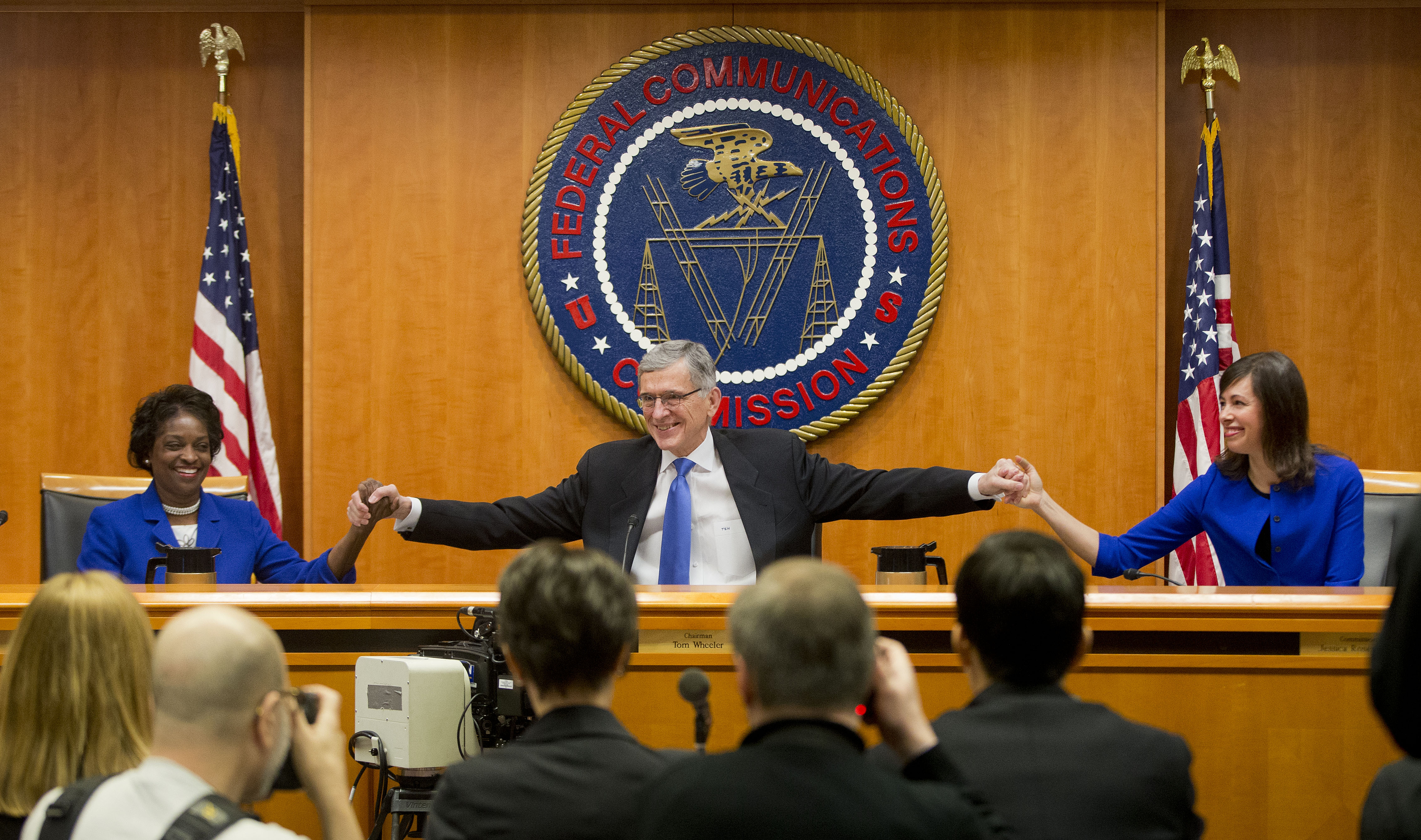
House Republicans will take action on a bill to cap the Federal Communications Commission’s newly expanded Lifeline program in April, after a compromise between partisan commissioners fell through at the last minute Thursday.

The FCC’s March open meeting was pushed back several hours Thursday after Republican Commissioners Ajit Pai, Michael O’Rielly and Democratic Commissioner Mignon Clyburn spent Wednesday night hammering together a bipartisan proposal to update the Lifeline program.

Otherwise known as the “ObamaPhone” program, the update allows low-income Americans eligible to receive a $9.25 monthly subsidy for telephone service to apply it to fixed or mobile broadband Internet. The Democratic proposal dropped by Chairman Tom Wheeler‘s office in March raised the Lifeline budget from almost $1.6 billion to $2.25 billion in an effort to get more low-income Americans online.

Absent from the plan is a budget cap, traded instead for a budget mechanism to alert the FCC when Lifeline reaches 90 percent of its spending threshold. The alert would give commissioners six months to take action — opening the door to another expansion and more of the systemic fraud and abuse plaguing the program in recent years, according to Republicans.

That’s why Pai circulated a compromise plan to cap the budget at $1.75 billion along with other changes ahead of Thursday’s meeting — a cap he was willing to raise to $2 billion when Clyburn, a longtime advocate of modernization, offered to work with the frequently shunned Republicans on a compromise.

The compromise was still in place shortly before Thursday’s morning meeting, which was delayed well into the afternoon as Clyburn’s office received calls “from a wide range of individuals” urging her to support Wheeler’s original plan, Clyburn said.

“On further deliberation, I concluded such a mechanism does not fully achieve my vision of a 21st century Lifeline program,” Clyburn said on her decision to side with fellow Democrats in a 3-2 vote to pass the original proposal, plus a few changes including a minimum of 500 minutes for mobile voice plans and a five year phase-out of voice-only plans.

According to Republicans, the pressure on Clyburn to toe the party line also came from within the FCC itself.

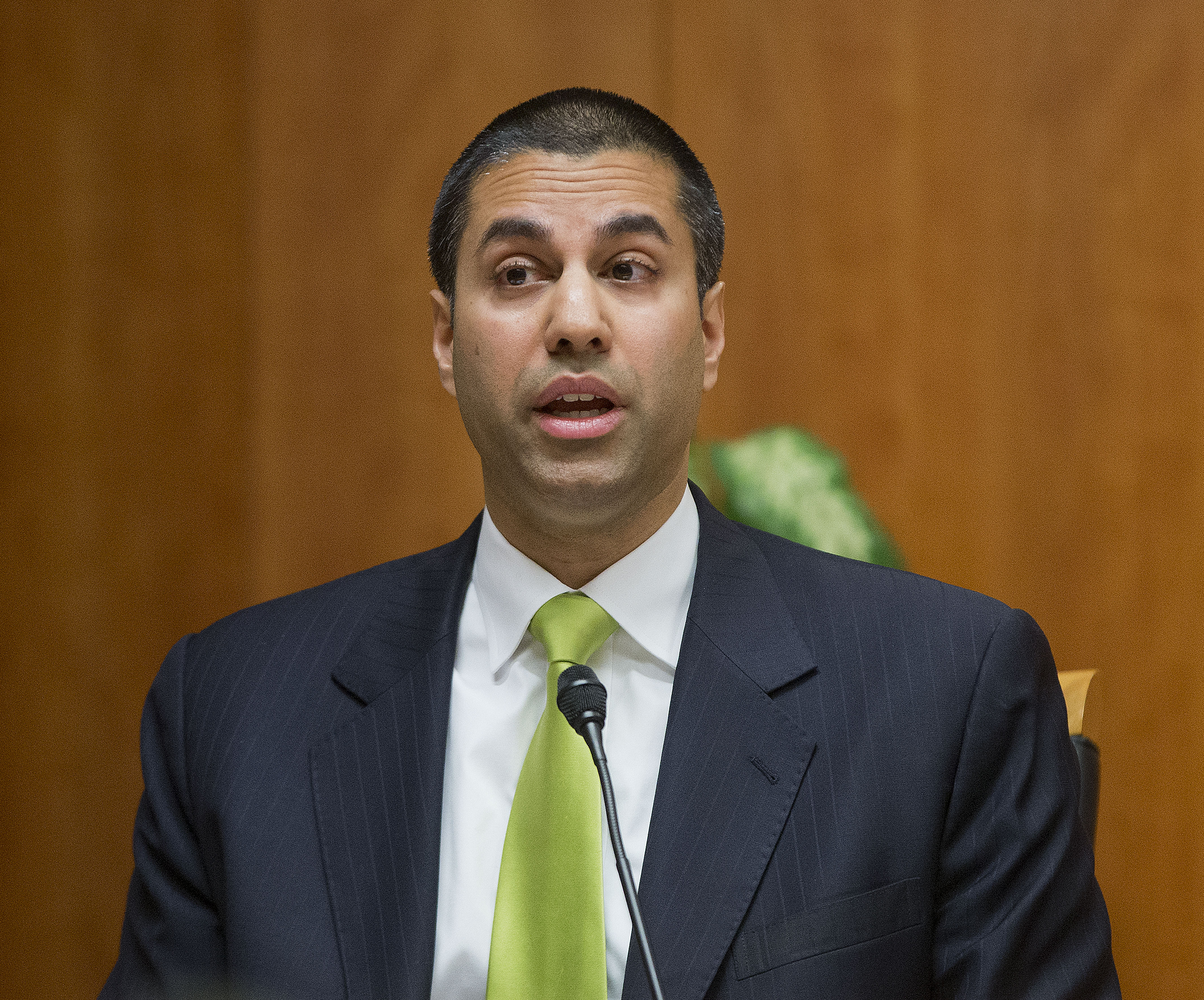
“This agency in this proceeding represented the worst of government,” Pai said in his dissent, pointing the finger at Wheeler’s office. “Bipartisan agreements that would deliver digital opportunity to millions of Americans are thrown away and even Democratic commissioners are bulldozed simply because the chairman can get away with it.”

O’Rielly said he wouldn’t trust Clyburn’s office again, adding her last-minute abort “reminds me of an old phrase on Capitol Hill,” he continued. “Never count on a Dem to hold their vote.”

Democrats on the House Energy and Commerce Committee put additional pressure on the FCC Thursday in a letter rejecting “an artificial cap,” which they said would leave “many low-income consumers” without “any mechanism to bridge the digital divide.”

“Demand is expected to increase as the program transitions to include broadband service, and any cap would threaten the goals and purpose of Lifeline,” the letter read.

After Thursday’s meeting, a spokesman for Republicans on the same committee said they plan to move on a bill by Georgia Republican Rep. Austin Scott, introduced earlier this week to cap the budget at $1.5 billion.

“While the program’s original purpose had merit, the program in its current form is wrought with fraud and abuse, and its past time for Washington to respond to the calls of our constituents to rein this program in,” Scott said Monday. “American citizens, who are all too familiar with ‘ObamaPhones,’ understand this and can agree that it is simple good governance to ensure we are curbing wasteful spending while also promoting accountability across the federal government.”

Groups backing the plan including New America’s Open Technology Institute say it’s crucial to deploying broadband to more low-income Americans.

“The FCC’s decision to update its Lifeline program means that broadband may now be within reach for millions more broadband users,” OTI senior counsel and director Sarah Morris said Thursday. “For decades, the Lifeline program has provided critical support for phone service, and today’s order reflects the evolving communications needs of low-income households.”

Skeptics of the plan say a bigger budget doesn’t necessarily translate to more subscribers, and suggest more fraud is the likely result.

“The last time Lifeline expanded, to cover mobile services, it was beset by waste, fraud, and abuse,” TechFreedom policy counsel Tom Struble said after the meeting. “The program ballooned in size, forcing the contribution factor to spike. This lined the pockets of opportunistic middlemen but, as the GAO recently reported, produced no observable increase in adoption.”

Any legislation to cap the program would likely be dead on arrival at the White House.

In a separate item, the commission voted Thursday to advance a plan establishing new data privacy regulations over Internet service providers.
Follow Giuseppe on Twitter

Republican FCC Commissioner Pitches ‘Fiscally Responsible’ ObamaPhone

One of the two Federal Communications Commissioners to vote against the agency’s plan to add Internet to Lifeline, the subsidized “ObamaPhone” program, is extending a “fiscally responsible” comprise to commissioners ahead of a final vote Thursday.

“Modernizing the FCC’s Lifeline program to support affordable, high-speed Internet access for our nation’s poorest families is a worthy goal,” FCC Commissioner Ajit Pai said Wednesday. “But failing to clean up the waste, fraud, and abuse in the program puts the entire enterprise in jeopardy.”

Earlier this month FCC Chairman Tom Wheeler dropped his plan to update Lifeline, which is designed to provide low-income Americans with a $9.25 monthly subsidy to help pay for the cost of telephone service. Under the new plan, consumers can apply the subsidy to broadband Internet service — a move the agency hopes will spur providers to offer bundled service plans for phone and Internet.

The proposal also ups the budget from $1.6 billion to $2.25 billion in an effort to reach more eligible enrollees, calls for the establishment of a “National Eligibility Verifier” to tackle the fraud and abuse that have plagued the program in recent years and puts in place a budget mechanism to notify the commission when it reaches a certain threshold.

According to Pai — who with lone Republican colleague Commissioner Michael O’Rielly voted against updating Lifeline last summer — those measures aren’t enough to protect American consumers, who pay for Lifeline with fees included on their monthly telephone bills, accumulating in the FCC’s Universal Service Fund.

“That’s why I’ve proposed to my colleagues a compromise to update the Lifeline program in a fiscally responsible way,” Pai said.

The Republican commissioner’s plan would reduce the Lifeline budget increase to $1.75 billion, enough to offer Internet access “to every single Lifeline-qualifying household” not online today, while maintaining landline voice service.

According to the FCC some 40 million Americans currently fall within the income threshold to apply for the subsidy, with only 32 percent — or about 13 million — currently enrolled.

It also establishes a budget mechanism of a different type, which instead of notifying the commission and promoting them to take action when it reaches 90 percent, reduces payments to carriers automatically when the estimated costs of the program would exceed the budget.

“As Senator Claire McCaskill recently wrote us, a mechanism must ‘prevent a repeat of the unchecked increase in spending that was seen the last time the program was expanded,'” Pai said. “My proposal would do just that without denying any eligible consumer a Lifeline subsidy.”

Shortly after Lifeline was expanded to include wireless service, the program’s budget rose an average of more than 25 percent per year from $821 million in 2008 to $2.1 billion in 2012.

Part of the rise in cost came from widespread fraud and abuse from consumers to wireless providers. The FCC reported 41 percent of the program’s six million-plus subscribers in 2012 failed to provide eligibility documentation, with many subscribers enrolling multiple times with falsified information to get a free cellphone along with the subsidy.

At the same time, several small wireless providers were caught enrolling the same customers multiple times for profit, prompting the FCC to implement reforms in 2012 including a database to prevent duplicate enrollees and fining cheating providers $96 million for negligence and fraud. As a result the budget was reduced in 2014 to its current $1.6 million.

Pai’s proposal also proposes to raise the minimum service standards in Wheeler’s plan from the minimum of 10 megabits-per-second download speeds to 25 Mbps for fixed broadband and from 3G to 4G LTE for mobile broadband.

“As Chairman Wheeler has put it, these speeds are ‘table stakes’ for digital consumers in the 21st century,” Pai said. “I believe low-income families and students deserve a seat at the table.”

Though Pai’s plan sets the bar more in line with the commission’s overall service standards, Democrats on the commission worry setting the standards higher could prompt providers to set higher minimum monthly payments, forcing subscribers to pay out-of-pocket to make up the difference.

The plan also does away with an enhanced $25 monthly subsidy in counties with more than 50 people per square mile, which Pai said “was intended to support the construction of facilities in Indian Country, but has instead encouraged abuse of the program in large cities … and suburban communities.”

Wheeler is unlikely to adopt the last-minute compromise ahead of the vote to implement the changes during the FCC’s March open meeting Thursday. During a congressional hearing last week Pai pointed out there have been twice as many party-line votes at the FCC since December 2013, one month after Wheeler became chairman, than during the previous four chairmanships combined.

The Republican commissioner testified during an earlier hearing the process at the FCC under Wheeler routinely leaves Pai and O’Rielly “in the dark,” while the remaining three Democratic commissioners develop proposals without Republican input.

Growing partisanship at the commission has not gone unnoticed by Congress, where lawmakers — including House Energy and Commerce Communications and Technology Subcommittee Chairman Greg Walden — have been seeking to update the commission’s rulemaking procedure and transparency.

“I believe true reforms require changes in law that can transcend any particular chairman or commission,” Walden said last week. “Unfortunately, sharp divisions within the commission are widely known.”

Follow Giuseppe on Twitter

FCC Votes to Add Internet to ‘Obama Phone’ Program

The Federal Communications Commission voted 3-2 Thursday in favor of a plan to expand the agency’s Lifeline phone subsidy program for low-income Americans to include broadband — the most contentious issue to divide Republicans and Democrats on the commission since net neutrality.

Chairman Tom Wheeler and Democratic Commissioners Mignon Clyburn and Jessica Rosenworcel voted to expand the program and give Lifeline subscribers the option to purchase broadband Internet service with the $9.25 monthly subsidy, currently used by low-income Americans to purchase landline or mobile phone service.

“At a time when America does business online, why should we continue to spend rate-payer funds only on 20th Century narrow-band service,” Wheeler said during Thursday’s open meeting at FCC headquarters in Washington.

“Why shouldn’t rate-payers — those hard-working Americans — know that their support is going to go help students learn, veterans to apply for benefits, job-seekers to apply for employment and a myriad of other modern challenges that increasingly can only be met online?”

Wheeler also pointed out that despite the political divide over the issue, Lifeline was both put in place and expanded under Republican presidents and past commission votes.

“Those who dissent on this notice today are against cleaning up the invitation to waste, fraud and abuse created by how the program was originally designed and managed,” Wheeler said.

Included in the expansion are reforms that would no longer let service providers determine the eligibility of enrollees for the subsidy — a measure Wheeler described as not only a conflict of interest, but akin to “letting the fox guard the hen house.” Under the expansion, providers would also be permitted to retain documents confirming enrollees’ eligibility, which they are currently barred from keeping.

Republican Commissioners Ajit Pai and Michael O’Rielly voted against expanding the program. Both argue Lifeline is inundated with fraud and abuse, and needs to be reformed before it can be expanded.

According to Pai, today’s Lifeline program, which came to be known as the “Obama Phone” program after it was amended to offer free instead of discounted phone service and a free phone, is far different from the iteration put in place 30 years ago under the Reagan administration.

“To equate the two is like saying that ‘The Godfather: Part II’ is the same as ‘Paul Blart: Mall Cop 2′ because both are movie sequels,” Pai told meeting attendees.

“My priorities for the Lifeline program, which I outlined almost a year ago, are clear. We must implement meaningful reforms to restore fiscal responsibility. We must root out waste, fraud, and abuse. We must target Lifeline spending on those who really need the help. And we must ensure that dollars coming from hard-working Americans’ phone bills each month are wisely spent.”

The Lifeline program was enacted in 1985 to help low-income Americans get telephone service by providing them with a subsidy to help cover the cost. The program was expanded to include cell phone service in 2005, and after the housing and financial crisis began in 2007, grew exponentially in use and cost. The Lifeline budget rose an average of more than 25 percent per year from $821 million in 2008 to $2.1 billion in 2012.

Part of the rise in cost came from widespread fraud and abuse across consumers and wireless providers. According to the FCC, 41 percent of the program’s more than six million subscribers in 2012 failed to provide eligibility documentation, with many subscribers enrolling multiple times with falsified information to obtain the free cellphone and $9.25 monthly subsidy. Meanwhile, wireless providers including Conexions Wireless, I-wireless and True Wireless were enrolling the same customers multiple times for profit.

The FCC implemented reforms in 2012, including a database to prevent duplicate enrollees and fining providers $96 million for negligence and fraud, and brought the cost of the program down to $1.6 billion in 2014. Lifeline is paid for by the FCC’s Universal Service Fund, made up in part by a “universal service fee” attached to Americans’ monthly phone bills — typically a few dollars based on a percentage of the total bill.

“Today, Lifeline spending and enrollment are still almost double what they were at the end of 2008,” Pai said. “Waste, fraud, and abuse are still rampant. And in a report issued earlier this year, the nonpartisan Government Accountability Office (GAO) ‘concluded that the Lifeline program, as currently structured, may be a rather inefficient and costly mechanism to increase telephone subscribership among low-income households.'”

The GAO report went on to note the “risk of significant costs to the program are even greater [with respect to broadband than voice] given that [the] FCC notes that a lesson learned from the broadband pilot program is that higher monthly subsidies have the highest participation rates.”

“Let me be clear. I am open to having a conversation about including broadband in the Lifeline program,” Pai said. “But any such change must go hand-in-hand with the reforms that are necessary to producing a fiscally responsible program. And this proposal fails that basic test.”

Pai and O’Rielly outlined a number of reforms they would have to see attached to any Lifeline expansion before they could vote for it, including a capped budget, a reduction in incentives to reduce fraud, a requirement for enrollees to make some contribution to their subsidized plans, and more aggressive enforcement from states and the FCC.

Following the vote Thursday, the agency will open a window to hear public comment on whether the program should be placed on a fixed budget, and what metrics should be used to grade its efficiency.

Follow Giuseppe on Twitter

Pai: Expanding ‘Obama Phone’ Program to Include Internet Will Mean More ‘Waste, Fraud, and Abuse’

Federal Communications Commissioner Ajit Pai cautioned Americans to be skeptical Wednesday of a forthcoming decision by the agency to consider expanding its Lifeline, or “Obama phone” program as it’s been called in recent years, to include broadband subsidies for low-income Americans.

The Lifeline program was instituted in 1985 to help low-income Americans get telephone service by providing them with a subsidy to help cover the cost of service. The program was expanded to include mobile phone service in 2005, and in 2008 with the onset of the Great Recession, grew quickly in both use and cost — with its budget rising an average of more than 25 percent per year from $819 million in 2008 to $2.19 billion in 2012.

A significant portion of the rise in cost came from widespread fraud and abuse from consumers and wireless providers. According to the FCC, 41 percent of the program’s more than six million subscribers in 2012 failed to provide eligibility documentation, with many subscribers enrolling multiple times with falsified information to obtain the free cellphone and $9.25 monthly subsidy. Meanwhile, wireless providers including Conexions Wireless, I-wireless and True Wireless were enrolling the same customers multiple times to profit from the subsidy.

After adopting reforms in 2012, including setting up a database to prevent duplicate enrollees and fining providers $96 million for negligence and fraud, the cost of the program came down to $1.6 billion in 2014. Lifeline is paid for by a “universal service fee” attached to Americans’ monthly phone bills — typically a few dollars based on a percentage of the total bill.

“So where does your hard-earned money go? Unfortunately, Lifeline, known in some circles as the ‘Obamaphone’ program, is plagued by waste, fraud, and abuse,” Pai wrote in a National Review op-ed Wednesday. “And ground zero for the program’s current woes is the state of Oklahoma.”

In Oklahoma’s tribal lands, Lifeline subscribers are eligible for $34.25 per month regardless of whether they are Native Americans or not. In 2014, Oklahoma cost the Lifeline program the second highest total — $128 million — despite the state ranking 28th in population. The vast majority of Oklahoma’s claimants — 99.5 percent — received the higher $34.25 subsidy.

On average, Lifeline costs $5 per person. In the Sooner State, the average is $33.01.

“So, for example, a non–Native American living in Tulsa is eligible for $300 more per year in phone subsidies than a low-income person in East Los Angeles or Appalachia,” Pai wrote. “Of the 307,434 Oklahomans receiving Lifeline support, only 339 do not qualify for the tribal subsidy, even though the vast majority of Oklahoma beneficiaries are not Native Americans.”

In the case of one former Oklahoma telephone company — Icon Telecom — the company defrauded the FCC out of more than $27 million with fake enrollees, which numbered 2,200 in 2011 and rose to 135,000 a year later.

“As a native of Parsons, Kansas, a small town near the Oklahoma border, I have a deep respect for tribal nations in Oklahoma,” Pai wrote. “But this federal spending in Oklahoma is outrageous. And excessive subsidies have made the state a playground for Lifeline fraud.”

On Thursday the commission is expected to advance and open up comment on the proposal by FCC Chairman Tom Wheeler to allow enrollees to purchase broadband service with the subsidy. The motion will likely be the most divisive vote since the agency adopted Wheeler’s net neutrality Open Internet Order earlier this year.

Before any expansion of the program, Pai argued Wednesday, the agency should reform the provisions still vulnerable to fraud and abuse.

“The FCC must act promptly to end this kind of swindle,” Pai wrote. “One option would be to provide the enhanced subsidy only in tribal lands with a low population density, where telephone services are less accessible and affordable.”

Pai said such reforms should also include a capped budget, a reduction in incentives to reduce fraud, a requirement for enrollees to make some contribution to their subsidized plans, and more aggressive enforcement from states and the FCC.

“These reforms — and others — must go hand in hand with any decision to begin providing broadband subsidies through Lifeline,” Pai wrote. “For the sake of all Americans who fund the program through taxes on their monthly phone bills, we cannot expand a broken program.”

Follow Giuseppe on Twitter