inside sources print logo
Get up-to-date news in your inbox

Biden’s NEPA Move Could Kill Future Energy Projects, Experts Say

The White House’s latest policy pronouncement has American energy producers struggling with the question, “What does Joe want?”

After weeks of pushing for more oil and gas production to fight higher gas prices and push back on Russian President Vladimir Putin’s invasion of Ukraine, the Biden administration has announced it is reinstating National Environmental Policy Act (NEPA) regulations, a move virtually guaranteed to make it harder to produce more energy.

“The administration’s NEPA rewrite adds more bureaucratic red tape into the permitting process, not only for natural gas and oil but for hydrogen, CCUS, wind, and solar,” said American Petroleum Institute (API) Senior Vice President of Policy, Economics and Regulatory Affairs Frank Macchiarola.

“So much for sticking it to Putin,” added Sterling Burnett, Director of Climate and Environmental Policy at the Heartland Institute.

NEPA, signed into law by President Richard Nixon in 1970, requires federal agencies to assess the environmental effects of their proposed actions prior to making decisions. “Using the NEPA process, agencies evaluate the environmental and related social and economic effects of their proposed actions,” according to the Environmental Protection Agency. “Agencies also provide opportunities for public review and comment on those evaluations.”

But as The Wall Street Journal reports, “Reviews can take years and run thousands of pages, covering the smallest potential impact on species, air, or water quality.”

Judicial rulings on the scope of NEPA had allowed the EPA to require a review of an infrastructure project — road, bridge, etc. — based on its “indirect” impact on climate, such as whether building a new road would encourage more driving and, therefore, more CO2 emissions. That level of review would have a disproportionate impact on new energy infrastructures like pipelines and refineries.

The Trump administration rolled back the “indirect” impact analysis and helped speed up the review process. Now the Biden administration has brought it back, requiring agencies to calculate the “indirect” and “cumulative impacts” that “can result from individually minor but collectively significant actions taking place over a period of time,” the Journal reports.

The new Biden policy appears to be at odds with the White House’s stated agenda of increasing domestic energy production to both lower consumer costs and take leverage away from Russia in the global energy market.

“The Biden administration’s actions reversing key permitting reforms threaten to delay or derail critically necessary energy infrastructure projects, from natural gas pipelines to wind turbine installations,” said Marcellus Shale Coalition president Dave Callahan. “Investment decisions rely on a consistent and predictable regulatory environment, and continued ambiguity is a barrier to America realizing the economic, environmental and consumer benefits of abundant domestic natural gas.”

Leslie Fields, Sierra Club National Director of Policy, Advocacy, and Legal, disagrees.

“NEPA plays a critical role in keeping our communities and our environment healthy and safe, and Donald Trump’s attempts to weaken NEPA were clearly nothing more than a handout to corporate polluters,” Fields said. “We look forward to the coming Phase 2 rulemaking and encourage the White House Council on Environmental Quality (CEQ) to finalize the strongest NEPA regulations possible, as soon as possible.”

Kenny Stein, Director of Policy for American Energy Alliance (AEA), considers this is another example of the Biden administration talking out of both sides of its mouth.

“The administration claims it wants to bring down energy prices and repair and replace America’s infrastructure, but then it takes regulatory actions like this that will make all federal permitting or federally funded projects slower and more expensive,” said Stein.

Gordon Tomb, senior advisor for the CO2 Coalition, agrees.

“The National Environmental Policy Act was passed to protect the environment in the development of infrastructure projects, a laudable objective,” says Tomb. “However, extremists perverted the process to essentially stop development forever.”

For example, Tomb says projects whose approval should have taken a year or two went on sometimes for decades or never happened at all.

“The Trump administration restored reasonableness to NEPA with defined time frames and a process that gave investors and others some level of predictability,” Tomb said. “By reversing Trump’s action, the Biden administration is returning chaos to the permitting of highways, pipelines, and other projects.”

The Heartland Institute’s Burnett says the return of more stringent NEPA reviews will impact the very infrastructure building the Biden administration celebrates.

“Road builders will have to account for the emissions from all the drivers that use the roads they construct in the future, none of which will have any measurable effect on the climate,” Burnett said. “Rather than “building back better,” these rules will virtually guarantee that almost nothing gets built at all.”
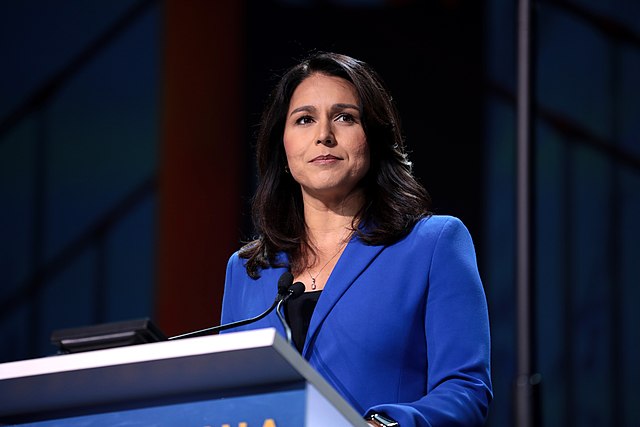
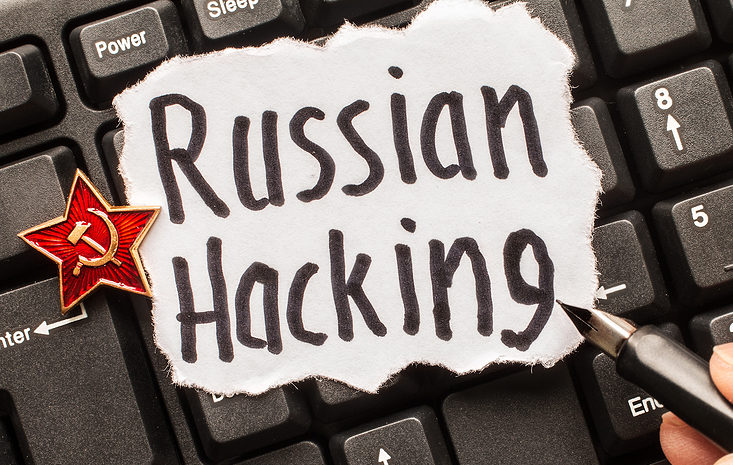
Mainstream Dems Ask: Is Tulsi Gabbard a Russian Asset?

The rumors started in October when Hillary Clinton suggested 2020 Democratic presidential candidate Tulsi Gabbard — who frequently criticizes and highlights the Democratic Party’s flaws — could be a “Russian agent.”

Of course, Republicans love Gabbard’s criticism of Democrats, and her comments have been picked up, praised and redistributed by moderate conservatives, white nationalists and Trump-supporting Russians alike.

The left-leaning mainstream press — who love moderate Democrat candidates and isn’t exactly shy about its dislike for Gabbard — pounced.

“What, Exactly, is Tulsi Gabbard Up To?” asked a New York Times news article.  MSNBC political commentators hosted a panel discussing how because Gabbard didn’t deny being a Russian agent which, they suggested, made the allegation more legitimate.

NBC News ran a story based on a report from the Foreign Policy Institute finding that Russian web trolls “boost Gabbard, boo Biden,” consistent with 2016 findings that Russian web trolls promoted Donald Trump and consistently shared negative coverage of Hillary Clinton.

The conclusion? Gabbard — like Trump — must be a Russian agent (never mind Special Counsel Robert Mueller’s report finding no collusion between Trump’s campaign and Russia in 2016).

Then Trump defended Gabbard, saying she wasn’t a Russian agent then adding, “[Clinton is] accusing everyone of being a Russian agent.”

His comments threw gasoline on the fire.

“Tulsi Gabbard may not be a Russian asset. But she sure talks like one,” reads an opinion headline from the Los Angeles Times, citing as evidence all of Gabbard’s critiques of her own party.

Apparently, that’s all a person needs to do to be a Russian asset: dare to criticize the Democratic Party.

Ironically, many of the establishment Democrats and Democratic policy positions Gabbard criticizes have also been criticized by 2020 Democratic contenders and senators Bernie Sanders (I-Vt.) and Elizabeth Warren (D-Mass.)

Most notably, both Gabbard and Sanders have been very vocal about their anti-war and anti-interventionist stances, a policy position most center-left Democrats don’t like. But Sanders isn’t receiving the same “Russian asset” treatment. Then again, left-leaning media organizations aren’t exactly fans of Sanders, either.

“If you’re not a ‘team player,’ then of course you’re a threat,” wrote Krystal Ball, liberal co-host of The Hill’s “Rising” news show. “When you are a threat to the political establishment, you are inherently a threat to the careers of journalists who rely on access to that political establishment.”

For Gabbard, that means her fellow Democrats and the media think she’s a Russian agent.

As CNN political commentator Ana Navarro-Cárdenas tweeted, “Folks, when both the Russians and Trump support someone, be wary. Be very wary.”

Perhaps that’s why she plans not to attend the December Democratic debate even if she qualifies. According to the latest polling numbers, she is hovering around 2 percent with Mike Bloomberg.

Follow Kate on Twitter

Mueller Report: Russians Easily Manipulated Social Media, Effortlessly Stole Voter Info

While Special Counsel Robert Mueller’s much-anticipated report found no evidence of conspiracy, Mueller describes in great detail how Russians easily manipulated social media companies like Facebook, Instagram, YouTube, Tumblr and Twitter to serve their own political ends.

The Internet Research Agency (IRA), funded by Yevgeniy Viktorovich Prigozhin (a Russian oligarch with ties to Russian President Vladimir Putin, and sanctioned by the U.S. Department of the Treasury in December 2016), operated hundreds of fake Facebook, Instagram, YouTube, Tumblr and Twitter accounts to spread pro-Trump and anti-Hillary Clinton messages leading up to the 2016 election, beginning as early as 2014, according to the Mueller report.

The scheme was simple but effective. According to the report, the IRA sent operatives to the U.S. in mid-2014 to “gather intelligence” and “obtain information and photographs” to fuel the barrage of fake posts and tweets leading up to the presidential election. The IRA targeted other presidential candidates, but focused on disparaging Clinton and supporting Trump by the summer of 2016.

“Some IRA employees, posing as U.S. persons and not revealing their Russian association, communicated electronically with individuals associated with the Trump campaign and other political activists to seek to coordinate political activities, including the staging of political rallies,” Mueller states in the report.

According to the report, the IRA reached “tens of millions of U.S. persons” through various social media accounts across different social media platforms.

“In November 2017, a Facebook representative (Facebook’s General Counsel Colin Stretch) testified that Facebook had identified 470 IRA-controlled Facebook accounts that collectively made 80,000 posts between January 2015 and August 2017,” Mueller writes. “Facebook estimates the IRA reached as many as 126 million persons through its Facebook accounts. In January 2018, Twitter announced it had identified 3,814 IRA-controlled Twitter accounts and notified approximately 1.4 million people Twitter believed may have been in contact with an IRA-controlled account.”

All of the IRA-controlled social media accounts claimed to be operated by U.S. citizens, even the political groups claiming to be grassroots activists.

“For example,” Mueller wrote, “one IRA-controlled Twitter account, @TEN_GOP, purported to be connected to the Tennessee Republican Party. More commonly, the IRA created accounts in the names of fictitious U.S. organizations and grassroots groups and used these accounts to pose as anti-immigration groups, Tea Party activists, Black Lives Matter protestors, and other U.S. social and political activists. … The IRA purchased dozens of advertisements supporting the Trump Campaign, predominantly through the Facebook groups ‘Being Patriotic,’ ‘Stop All Invaders,’ and ‘Secured Borders.'”

The IRA-controlled social media accounts were so convincing that Trump supporters and members of Trump’s campaign — like his son, Donald Trump, Jr. — frequently retweeted and shared the pro-Trump propaganda across social media, presumably unaware they were participating in a Russian propaganda campaign.

But manipulating social media companies is only half the story.

The report also details how easily Russians hacked the Democratic National Committee (DNC). The way Mueller describes it, it was practically child’s play.

Russian Federation’s Main Intelligence Directorate of the General Staff (GRU) hacked the DNC via a VPN connection from the Democratic Congressional Campaign Committee (DCCC) and also hacked computers and email accounts belonging to Clinton’s campaign, stealing hundreds of thousands of documents beginning in March 2016. No one even knew about it until the documents were released via WikiLeaks in the fall of 2016.

The GRU also stole voter information from the Illinois State Board of Elections and later conducted a spearphishing email attack against a voting technology company, VR Systems, which (Mueller said) the FBI believes granted the GRU access to “at least one Florida county government.”

During the 2018 midterms, Republicans mocked Sen. Bill Nelson (D-Fla.) for worrying about Russian influence in Florida elections.

The GRU did all this without local or state government knowledge. But the sheer laziness with regard to cybersecurity didn’t surprise Stuart Madnick, a professor of information technology and engineering systems at MIT’s Sloan School of Management.

“It’s not a surprise that anyone can be hacked with some effort,” he told InsideSources. “You can go down a list of companies that should have the expertise and resources to protect themselves. We pay a lot of attention to the things that happen at Yahoo or Facebook or Target, these are multi-billion dollar corporations. We forget there are hundreds of thousands of small organizations in the country, whether your local pizza company or local DNC [with little to no cybersecurity]. There are hundreds of thousands of organizations no different from the DNC, and according to a recent report, they’re now the prime target for cyberattacks.”

Ironically, the DNC misreported a cyber attack last summer ahead of the 2018 midterm elections, which the DNC later explained was just a cybersecurity test by the Michigan Democratic Party. Madnick says this just shows how uneducated, understaffed and under-resourced so many companies and organizations are when it comes to cybersecurity.

“I suspect the DNC does not have a huge IT department,” Madnick said.

The kind of manipulation and hacking social media companies, political and government entities experienced in 2016 shouldn’t have happened in the first place. As Madnick pointed out, republics and democracies have dealt with various forms of election interference for hundreds of years.

“The role media can play in elections is not new, all we’re seeing is a new twist on it with new technologies,” he said. “The ethical and moral issues have been around for a long time, and maybe need to be reexamined and thought about under the new circumstances.”

At the same time, given the DNC’s blunder last year and the fact that so many state and local governments suffer from a lack of funding and resources when it comes to IT management and cybersecurity, the U.S. is still extremely vulnerable to more cyber-related election interference.

Big Tech, too, still hasn’t addressed privacy concerns of users and Facebook only recently started offering more details about who pays for the political ads on its platform.

Yesterday, Facebook confirmed to the Verge that when it required users to verify their email addresses a month ago, Facebook uploaded users’ email contacts to Facebook’s servers without their consent. Facebook claims this was an accident and claims it fixed the problem, but Facebook’s method of email verification was also unorthodox, because it involved taking users’ email passwords.

Facebook’s behavior doesn’t exactly instill confidence in American voters going into 2020. Facebook still doesn’t even have a chief security officer.

“They are [all] relatively easy targets,” Madnick said. “You don’t have to look really hard to find a back door unlocked. If DNC gets broken into next year with a different technique, I wouldn’t be surprised.”

Follow Kate on Twitter

Christmas in Europe Coming Under Leaden Skies

AGRINIO, Greece — There is not a dark cloud hanging over Europe. There are a bunch of them. Taken together they account for a sense of foreboding, not quite despair, but a definite feeling that things are unraveling and, worse, that there is no leadership — second-raters at all the national helms. That was the near consensus at the annual Congress of the Association of European Journalists here in lovely western Greece.

In a class by itself in worries in Europe is Russia. It is creating trouble all over Europe, but especially in the countries that made up the former Soviet Union. It has a propaganda effort the likes of which has not been seen since the days of the Cold War — except modern technology and its social media manifestation have made it more deadly, surreptitious and deniable.

The problem is one that affects news organizations directly. Fake events vie with pernicious posting on social media and relentless cyber-undermining of systems and processes.

Disparaging democracy seems to be a primary Russian goal, making it appear unworkable.

When will Russia move from soft war to hard war? The current standoff over Crimea augers badly for vulnerable Russian neighbors, particularly the Baltic states of Estonia, Lithuania and Latvia. They are battling massive Russian undermining of truth and wonder whether they will fall again to the Russian bear.

Add to this fear a new dynamic: What will America do if Russia moves? The fear is it will do nothing. President Donald Trump’s haranguing of the NATO allies is not reassuring to them.

After the existential worries about Russia, comes Brexit. It is here and now. It is, in the eyes of continentals, a ghastly mistake that is going to cost all of Europe dearly. And what for? The vague shibboleth of “sovereignty.” Euros remain sadly hopeful that somehow there will be a second referendum in Britain and that everything will be as it was: Britain being a stabilizer among the 28 nations that make up the European Union.

Since Britain’s entry in 1973, it has been a fundamental side of an iron triangle of the three big economies: Germany, France and Britain. Britain has been an older sibling, the sensible one. Now the odds are that it will be gone, headed for an uncertain future leaving behind the wreckage of a broken marriage and squandered hope for what Tony Blair, the former Labor prime minister, used to call the “European Project.”

Hungary and the ultra-right policies of Viktor Orban are a very great worry in Europe. Similarly, Poland’s shift to the right and the success of right-wing, near fascist parties across Europe, including Austria (heretofore a center of cautious reasonableness), add to the sense of disintegration.

Two other worries are France and Italy. Along with Hungary and Poland, Italy, with an amalgamated government of the ultra-right and ultra-left, looks as determined as the other two to thumb its nose at the European Union and its rules, maybe to withdraw even. Hungary does it over press freedom and human rights, Italy over fiscal probity and open hostility to the EU.

France is a different story. Emmanuel Macron, the young president was, briefly, the great hope of Europe, but his popularity at home has slid and he has had to turn back his ambitious reforms after street demonstrations, violence and fatalities.

Add to all this shifting sand the uncertain future in Germany where Chancellor Angela Merkel is on her way out and, suddenly, she seems a more desirable leader than she was thought to be during her tenure.

Feeding the swing to the right and as far from resolution today as it was when it began, illegal immigration is an undermining pressure, un-addressed on the left and exploited on the right.

Meanwhile, across Europe press freedom is teetering: a big issue at this congress. As a Bulgarian delegate said to me, “When the press goes, so goes democracy.” Then she added, “We thought that, in some way, America would help, but not now. We are on our own.”

Europe will have a fine Christmas — it does Christmas so well. Next year though, some of the stresses may reach breaking point and the carols will have given way to uglier, discordant notes.

Here’s What the Tech Industry Should Expect From a Democratic House

Tech experts expect the new Democratic majority in the House will prompt a fresh wave of tech industry scrutiny that will likely result in bipartisan legislation. And at the top of the to-do list is consumer data protection and privacy.

“There’s a lot of anger about how the Equifax data breach went down and how there’s been no repercussions for that,” Philip Berenboick, senior policy counsel at Public Knowledge told InsideSources. “Since Equifax we’ve had the data breach with Facebook, the Cambridge Analytica situation with Facebook, and other data breaches with Target and Sony, so data protection and consumer privacy is something that’s really ripe for action from a committee. That’s probably something we’ll see in the first quarter.”

And a Democratic majority also means more aggressive oversight of the tech industry and the federal agencies who regulate it.

“I think there’s going to be a lot more oversight on telecom companies and those companies are going to get called up to the Hill for hearings,” he said. “There are lots of committees that have oversight over tech issues and a lot of Democrats who have watched Republicans hold hearing after hearing where they bring in witnesses from industry-friendly think tanks and right-wing advocacy organizations. I think we’re going to see a lot more witnesses that have a consumer protection bent and more hearings focused on what government is and isn’t doing and how that’s impacting consumers, small business, competition. It’s going to be a more stark conversation than what we’ve been seeing over the last two years.”

Roslyn Layton, a visiting fellow at the American Enterprise Institute specializing in tech and internet policy, told InsideSources that because consumer data protection and privacy legislation are already bipartisan concerns highlighted in hearings over the past few months, she’s hopeful some kind of bipartisan cooperation on a consumer data protection and privacy bill will gain traction.

“The Democrats have wanted to demonstrate they’re on top of Silicon Valley and they can tame it, if you will,” she said. “Even with a divided Congress, there is a high probability that Congress will move forward on comprehensive privacy legislation. Both parties care about privacy, consumer protection and demonstrating that appropriate policy needs to be in place to discipline online actor when harm arises.”

Of course, the devil is in the details: as the last round of consumer data and privacy hearings showed, the tech industry and consumer advocates have very different ideas about how to approach legislation.

Lindsay Gorman, managing director at Politech Advisories, told InsideSources that while there’s potential for bipartisan cooperation, privacy legislation could easily devolve into symbolic politics.

“An interesting area to look at in data protection that will almost definitely come up is threats to democracy and election security,” she said. “There might be an opportunity for legislation that deals with these threats to democracy that arise from companies sharing personal data without many protections.” However, Gorman said, with the Russia hacking investigation in the background, “there’s a high chance it will be overly politicized and might be difficult to build any kind of consensus.”

The Center for Democracy and Technology’s (CDT) Vice President for Policy Chris Calabrese told InsideSources that there could be tension between Democrats and Republicans regarding how Democrats go about legislating the tech industry.

For example, he said, Democrats will want to give agencies like the Federal Trade Commission (FTC) more rule-making authority— something the tech industry does not want.

“I think it’s worth noting the Democrats have been cagey about what exactly they’re looking for in a privacy legislation and what they’re interested in pushing,” he said.

Echoing Gorman, Calabrese also thinks Democrats will go after data privacy as a national security issue.

“One area we will see additional work on the tech side is questions around misinformation and the use of tech to potentially influence elections,” Calabrese said. “I think we could use some more neutral and evidence-based analysis of that issue. Right now the question has been pretty partisan and tied very closely to particular legislative outcomes. Maybe now we can start to say, regardless of the outcomes of a particular election, what influence do we think this type of advertising has, and how do we make sure we have a policy debate that’s based on the facts rather than people just being upset about a specific legislative outcome?”

Follow Kate on Twitter

Oops. DNC Cyber Attack Backtrack Casts Doubt on Midterms’ Security.

The Democratic National Committee told the press its voter database was hacked on Monday, then Wednesday the DNC’s Chief Information Security Officer Bob Lord issued a statement clarifying the hack was actually a cybersecurity test run by the Michigan Democratic Party.

As this particular attack was a false alarm, it is unclear why the DNC rushed to declare the incident a cyber attack in a scenario similar to the Federal Communications Commission’s (FCC), which was unraveled a few weeks ago.

In fact, the DNC’s rush to judgment suggests it may not be prepared for the upcoming midterm elections despite aggressive efforts to beef up its cybersecurity following the Russian hacks in 2016.

The DNC test, which mimicked a phishing attack, impersonated the DNC’s VoteBuilder login page in an attempt to steal voter and potential voter data. VoteBuilder is the software the DNC uses to store voter data and track interactions with potential voters.

Earlier this year, the DNC poached Lord from Yahoo as part of its push to improve cybersecurity measures.

According to a July POLITICO report, the DNC was apparently getting better at catching phishing attacks via tests. POLITICO reported that 80 percent of DNC staffers didn’t click the links in phishing emails, but also pointed out that the DNC has struggled to improve its security and technology culture.

Stuart Madnick, a professor of information technology and engineering systems at MIT’s Sloan School of Management, told InsideSources that he thinks the DNC incident is very similar to the FCC’s. In May 2017, the FCC’s public comment system crashed and the FCC called it a cyber attack, but an Office of the Inspector General investigation recently found it was very unlikely a cyber attack had occurred.

“The thing that’s so odd about all this is how early it was reported,” Madnick said. “Almost any organization nowadays experiences attacks on a daily basis. These things happen all the time. Why this is something they wanted to go and publicize, that’s the mystery. Right now there’s the Russian hacking boogeyman out there so everywhere you turn you see it.”

Madnick also said it doesn’t make sense why the DNC would report the suspected attack to the press so quickly simply because authorities generally advise against it.

“One of the things that’s interesting is, the authorities like the police or FBI will say it’s not a cyber attack so they can investigate it further,” he said. “They saw them get hit before, and this time they guessed it was another cyber attack.”

The DNC could have gone to the press immediately for political purposes to appear as a victimized target (alluding to Republican or Russian interference), but Madnick — and the Center for Strategic and International Studies’ Vice President James Lewis — think the DNC is just “gun-shy.”

“People are jumpy, especially the DNC, about being hacked,” Lewis told InsideSources. “It’s no surprise to anyone that the Russians might try something like this. It’s the flavor of the year to say cybersecurity. People don’t have a lot of experience and it’s very exciting when it’s happening to them and they rush out and say it.”

Madnick said that despite an organization’s best efforts to run tests and prepare for a potential cyber attack, it is often difficult for an organization to truly know when it is being attacked. There’s really “no guarantee,” he said.

Furthermore, the DNC’s rush to call the incident a cyber attack reveals hyper-awareness regarding cybersecurity, which is more a good thing than a bad thing.

“The good news is, what Michigan was doing is exactly what the DNC should have been doing, to see how good their protection is and how alert they are,” Madnick said. “A lot of times they’re trying to see if someone is on alert.”

But even if an organization like the DNC is on high-alert, it could still lose critical, sensitive information to hackers.

Lewis thinks the DNC’s move to report the incident to the press was the right one, even though the DNC ended up being wrong.

“You get punished if you’re caught being attacked and not announcing it publicly,” he said. “Trying to conceal it and then it comes out, and then you look bad. And you think I don’t want that to happen to me, so then you come out and say it’s a cyber attack. It’s complicated. I think they say better to come out and say we were hacked than be caught trying to conceal it.”

Furthermore, he continued, “There’s been a lot of indicators that the Russians are up to their old tricks, so you can see why people came to this conclusion, it was just too early. My thought is people thought better safe than sorry.”

Given all the press coverage regarding election security and the upcoming midterms — with several stalled election security bills in Congress and various states struggling to foolproof their systems — the DNC incident doesn’t exactly instill confidence in midterm elections’ security.

If it’s so difficult for the DNC to tell the difference between a test and a real attack, then it’s unlikely others will know the difference either on Election Day, potentially compromising thousands or millions of voters’ data or votes.

But Madnick thinks midterm concerns may be overblown.

“I think there is a heightened sense of awareness and concern [about] election manipulation, almost to the point of overreacting,” he said. “I would have thought it was in the DNC’s best interest not to report it to the press, by alerting the press, it makes it look more like a real attack, and makes it counterproductive.”

Ultimately, he added, there’s really no guarantee.

Follow Kate on Twitter

Congress Concerned About Fake Net Neutrality Comments From Russia

The number of Trump administration agenda items that have escaped the specter of Russia is shrinking. During a congressional hearing Wednesday, Federal Communications Commission appointees seeking Senate approval were questioned about more than 300,000 fake comments from Russia meant to influence the Trump administration’s plan to repeal net neutrality rules.

Those 325,528 comments originating from one Russian address came up during the Senate confirmation hearing of three Trump appointees to the FCC, including the reconfirmation of Trump’s pick to lead the agency, Republican Ajit Pai. Pai voted against the Obama-era rules in 2015 and proposed a plan to repeal significant portions of them earlier this year.

Senator John Thune, chair of the Senate Commerce, Science and Transportation Committee, said 1.3 million comments came from international filers “with more than 300,000 coming from the same address in Russia in support of the 2015 Title II rules.”

“And there have been many other stories of fake or abusive comments being filed,” the South Dakota Republican said.

Ranking Democrat Sen. Bill Nelson of Florida agreed with a comment alluding to the Trump administration’s alleged ties to Russia during the 2016 presidential campaign.

“Isn’t it interesting we have to be concerned about comments being filed from Russia?” Nelson asked Thune. “It’s a new day.”

Pai expressed confidence the agency wouldn’t be swayed by illegitimate comments, and instead explained the FCC would ultimately be guided by standards set down in the Administrative Procedure Act. The law requires agencies adopt rules based not on the number of comments filed for or against a proposal, but on the factual and legal reasoning within.

“I do understand there have been concerns on all sides about the veracity of some of these comments,” the FCC chairman replied. “We’re ultimately guided by the substantial evidence test . . . has the agency collected evidence that a reasonable person would agree would be adequate to support whatever conclusions were ultimately made?”

The comments from Russia were uncovered along with another 300,000-plus from Germany, more than 100,000 from France, and almost 477,000 from the U.S. “but entered into the system as ‘international filer,'” data gathered on comments submitted to the agency from July 3 to July 12 indicates.

According to the National Legal and Policy Center (NLPC), the right-leaning non-profit that reported the comments, thousands of the comments “appear to come from fake email addresses and fake physical addresses overseas” and “came almost exclusively from the email domains Pornhub.com and Hurra.de (Germany).”

“At this point, the deception appears to be so massive that the comment process has been rendered unmanageable and meaningless,” NLPC President Peter Flaherty said. “More ominously, with hundreds of thousands of comments appearing to come from Russia, we must ask ourselves whether once again, Russian interests are attempting to sow chaos in U.S. official policymaking proceedings.”

Wednesday’s hearing wasn’t the first time fake comments came up in Congress. House Democrats asked federal investigators to look into a slough of fake comments submitted in support of the Trump administration’s plan to scale back the rules, some using real names and addresses of people who did not file comments.

Activists on both sides of the debate point to hundreds of thousands of fake comments against their positions. Congressional Democrats even question the FCC’s own transparency with regard to a cyberattack that crashed the agency’s online comment filing system. The crash followed a “Last Week Tonight with John Oliver” segment opposing Pai’s plan in May.

Despite the allegations of fraudulent comments, FCC General Counsel Brendan Carr, Trump’s nominee to fill the open Republican seat on the commission and a former advisor in Pai’s office, said comments still have weight.

“I think it’s very important,” Carr said. “I think it shows the level of interest and the passion in this issue, and that’s something we need to be taking into account.”

Former FCC Commissioner Jessica Rosenworcel was also on hand to answer questions in hopes of being confirmed to fill the Democratic seat she was forced to vacate in December. At the time, Republicans declined to reconfirm her appointment, preferring instead to give incoming President Donald Trump the choice to nominate her. He did so in June.

Rosenworcel didn’t shy from taking up her past positions. She expressed support for net neutrality and disagreed with Pai on issues like maintaining funding for the FCC’s E-Rate program, which helps schools and libraries pay for high-speed broadband, as well as supporting FCC regulation of cybersecurity practices.

Follow Giuseppe on Twitter

Subscribe for the Latest From InsideSources Every Morning

Dartmouth Professor Concerned About Spread of Liberal Conspiracy Theories on Social Media

One hears about right-wing media sites, like Breitbart, InfoWars, and Gateway Pundit, spreading conservative conspiracy theories almost on a daily basis. The latest comes from Fox News’s Sean Hannity who kept talking about the debunked theory that Seth Rich, a staffer at the Democratic National Committee who was shot dead near his Washington, D.C. home, had supplied DNC documents to WikiLeaks and was killed for it. While those stories get covered extensively by mainstream media, a Dartmouth professor is concerned that liberal conspiracy theories are also being spread across social media.

In an interview with New Hampshire Public Radio last week, Brendan Nyhan, a professor of government at Dartmouth College and New York Times contributor, explained there are many conspiracy theories or fake news stories about President Donald Trump and his possible campaign connections to Russia.

“I’m seeing a disturbing trend of people taking the very serious and real questions about Russian interference and using that as a pretext for all sorts of wild and unsupported conspiracy theories. These are often coming from internet personalities and people who work on social media, but they’re infiltrating into the discourse more generally through liberal elites who are amplifying them. So we’re seeing a spread of these claims out into the mainstream in a way that I think is potentially worrisome.”

He points to several examples in the past few weeks of the spread of misinformation online that has reached a mainstream audience. On Lawrence O’Donnell’s MSNBC show “The Last Word,” he gave legs to the theory that Russian President Vladimir Putin ordered the chemical weapons massacre in Syria to help Trump’s popularity ratings by encouraging him to launch a missile strike.

“It’s important to remember Democrats spent the last eight years complaining about the birther myth and all sorts of conspiracy theories around Barack Obama and Hillary Clinton, and now just a few months later, here we are,” Nyhan said.

The rise of liberal conspiracy websites or social media personalities, especially on anything related to Trump and Russia, has been analyzed by a few media outlets.

“Liberals desperate to believe that the right conspiracy will take down Donald Trump promote their own purveyors of fake news,” wrote Sarah Jones of The New Republic.

“By embracing every single tweet or whisper as yet another piece of full-proof evidence of just how terrible Republicans are, Democrats run the risk of appearing like the boy who cried wolf to the public — and in the process taking some steam out of the very legitimate questions they are asking about the Trump administration,” wrote Chris Cillizza of CNN.

Vox’s Zack Beauchamp calls it the “Russiasphere.”

“They worry that the unfounded speculation and paranoia that infect the Russiasphere risk pushing liberals into the same black hole of conspiracy-mongering and fact-free insinuation that conservatives fell into during the Obama years. The fear is that this pollutes the party itself, derailing and discrediting the legitimate investigation into Russia investigation. It also risks degrading the Democratic Party — helping elevate shameless hucksters who know nothing about policy but are willing to spread misinformation in the service of gaining power.”

Another theory was spread after Republicans passed the American Health Care Act earlier this month. A reporter tweeted about a large supply of beer in the Capitol. Liberals took that ammo and fired off theories that spread like wildfire on social media that the beer was going to a GOP meeting celebrating the bill’s passage.

The theory was later found to be false, and even though the reporter tweeted a correction, that tweet only got a handful of retweets. Mic’s headline is indicative of the early coverage: “Republicans celebrated taking away Americans’ health insurance with cases of beer.” (The millennial news site has since changed the headline to: “Reports of beer delivery to GOP health care celebration called into question.”)

But Nyhan said the damage was already done.

“People are looking for bits of factual information that seem to confirm a pre-existing narrative. This is the problem with confirmation bias,” he said. “We’re seeing that sort of pattern in much more serious circumstances when it comes to the Russia investigation where every piece of information that comes out is being spun and interpreted in the worst possible ways, and in some cases, we’re seeing outright fabrication and speculation being reported and amplified.”

Not everyone is convinced, though, that leftist conspiracy theories are being spread as much as conservative ones. Jeet Heer of The New Republic wrote a counterargument analysis saying while there’s no denying that conspiracy theories are spread on the left, only the Democratic Party acts “responsibly when faced with politically convenient, but obviously fantastic, stories.”

“There still exists a feedback loop on the left, so when a prominent person falls for a conspiracy theory, they are challenged by the media and willing to correct themselves,” he wrote. “Conversely, conservatives tend to adhere to a ‘no apologies’ ethos that makes admitting error verboten.”

In a survey administered by Survey Sampling International immediately after the election (Nov. 7-10, 2016), found that partisans’ conspiratorial predispositions can vary depending on which party holds political power. Democrats’ “conspiracy scores” increased significantly compared with a previous survey in July 2016.

The percentage of Democrats who agreed on average with the conspiracy claims in the scale increased from 27 percent before the election to 32 percent after the election. By contrast, Republicans’ willingness to endorse conspiratorial claims declined after the election over all, decreasing the percentage of Republicans who agreed on average with the false statements from 28 percent to 19 percent.

Nyhan said everyone plays a part in spreading misinformation and more people should be willing to publicly correct themselves if they get a fact wrong or spread a debunked theory.

“We all can take some responsibility for this in the kinds of information we share on social media,” he said. “We’re all potentially complicit in the spread of misinformation. Everyone will be fooled. That’s part of the medium, for better or for worse. What I’ve been disappointed to see is how many people don’t exercise the appropriate care in what they do amplify and fail to correct the record when the information they’ve circulated turns out to be wrong.”

Follow Kyle on Twitter.

Sign up for NH Journal’s must-read morning political newsletter.

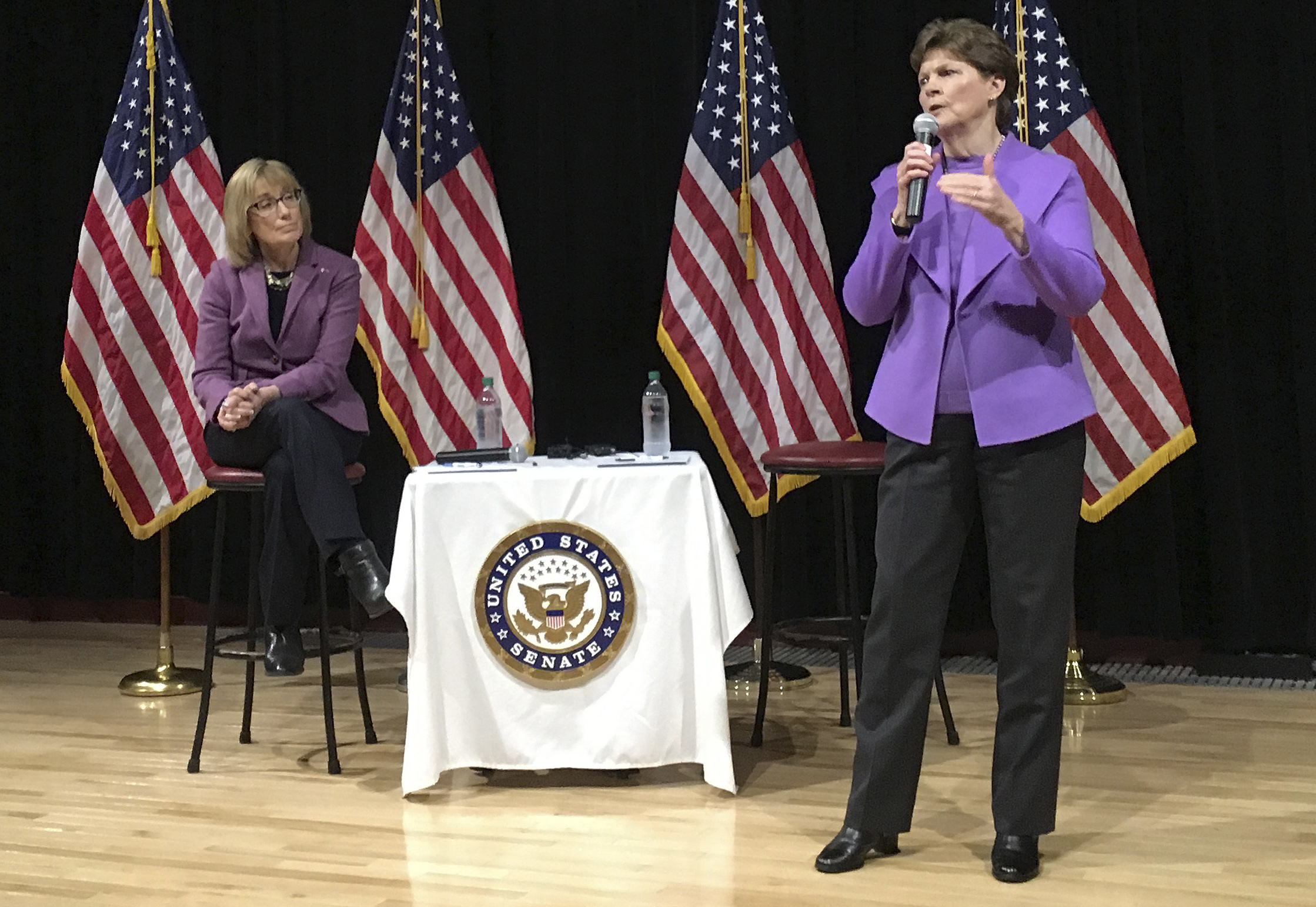
Hassan, Shaheen’s Town Hall Reveals Middle-of-Road Approach to Trump

U.S. Sens. Maggie Hassan and Jeanne Shaheen’s town hall-style meeting on Friday with their New Hampshire constituents was mostly a warm welcome back to the state. Unlike many of their Republican colleagues who have dealt with protesters, shouting, and many interruptions in their town halls during Congress’ recess week, Hassan and Shaheen received very few interruptions during their question-and-answer session, receiving mainly applause during the hour-long event.

While the positive feedback from the audience showed general approval of their job so far in the Senate, the town hall also revealed that Hassan and Shaheen aren’t some of President Donald Trump’s biggest opponents in the Democratic Party.

While the two senators have made it clear that they do not approve of many policies and much of the rhetoric coming from the Trump administration, they have been more bipartisan in their approach to Trump than others.

For example, Hassan and Shaheen have both approved of seven of his Cabinet nominations and opposed seven of them. That puts them on the lower end of “no” votes in the Democratic Party, with only five Democrats and one Independent who caucuses with the Democrats having fewer “no” votes.

Senators in states that Trump won or who are expected to face tough reelections have fewer “no” votes, including Sens. Joe Manchin of West Virginia, Heidi Heitkamp of North Dakota, Claire McCaskill of Missouri, and Independent Angus King of Maine, Joe Donnelly of Indiana, and Mark Warner of Virginia. Most senators have eight or nine “no” votes for Trump’s nominees, with potential 2020 Democratic-presidential hopefuls disapproving of 12 or 11 of his appointments, including Sens. Kristen Gillibrand of New York, Cory Booker of New Jersey, Elizabeth Warren of Massachusetts, and Independent Bernie Sanders of Vermont, who caucuses with Democrats.

While Hassan and Shaheen’s cabinet votes weren’t the main focus of Friday’s town hall, their position on Trump’s Supreme Court nominee, Neil Gorsuch, received the biggest disapproval.

Both Democrats rejected the idea of blocking a hearing for Gorsuch, resulting in audible boos and shouts of “no” from the audience.

“It is not in our interest to deny a hearing to Neil Gorsuch,” Shaheen said. “That’s what’s prescribed under the Constitution. Let me tell you something. I’m not going to go out and say it’s wrong for them and then say that it’s right for us.”

Shaheen was alluding to Republican Senate leadership’s refusal last year to hold a hearing for former President Barack Obama’s nominee, Merrick Garland. Some Senate Democrats have previously stated they want to filibuster or block Trump’s nominee from ever getting a hearing, just like the GOP did to Garland.

Yet, neither senator said they have made a final decision yet on how they will vote for Gorsuch. His confirmation will require 60 votes, so some Democrats will have to cross party lines if he is to get the seat on the bench.

“I think it is absolutely appropriate and right for us to do our constitutional duty and have a hearing,” she said.

Hassan said she plans to meet with Gorsuch this week to discuss “the protection of civil rights for all Americans. In my view that includes the rights of the LGBT community. It includes the rights of women to make their own health care decisions.”

In addition to Hassan and Shaheen’s middle-of-the-road approach to the Supreme Court nominee, they have also not gone to the same extremes as other Senate Democrats when it comes to Trump and Russia.

“I never thought that I’d begin my tenure having to stand up to a president whose conflicts of interest and whose campaign and administration’s involvement with Russia would cause so many questions,” Hassan said. “I also think that it is concerning that a president who is so tough on our allies seems so soft on Russia. I think that raises real questions.”

Hassan and Shaheen have joined several Democrats who have called for an independent commission investigation of possible Trump administration ties to, and communication with, Russian officials, in addition to possible Russian interference in the 2016 presidential election. Several high-profile Republicans, including Sens. John McCain of Arizona and Lindsey Graham of South Carolina, also said they support similar measures.

“The American people need to know what happened here, and then we need to take appropriate action,” Shaheen said.

However, Hassan and Shaheen didn’t go as far as other Democrats who have publicly talked about the possibility of impeaching Trump.

Hassan told WMUR after the town hall that impeachment talk was “premature,” yet restated her support for an independent investigation into Trump’s ties to Russia.

“I think it’s really important that we investigate concerns we’ve heard about connections to Russia in the Trump administration, and I think it’s very important that we have a bipartisan commission for the same reason,” she said.

It makes sense for Hassan and Shaheen to take a more bipartisan approach to Trump given the political climate in New Hampshire.

Democratic nominee Hillary Clinton won the state over Trump by only three-tenths of a percent — 46.8 to 46.5 percent. Hassan’s victory over former GOP Sen. Kelly Ayotte was even narrower, winning only by 743 votes, and while the Granite State sent an entire Democratic delegation to Congress, the GOP won the majority in the Legislature and took back the corner office for the first time in 12 years. Many people call New Hampshire a “purple” state, since it usually swing back and forth between red and blue every election. Hassan and Shaheen can’t upset their base too much, but they also can’t alienate the independents and moderate Republicans in the state either.

Near the very end of the town hall, Shaheen and Hassan also said they would do what they can to address climate change. Yet, some in the room weren’t happy with what they saw, including one man who shouted that the two women were using plastic water bottles, instead of reusable ones.

Hassan stated she is willing to work with Republican senators, but not at the risk of undoing progress.

“There is a difference between constructive compromise and undermining the progress that we have made,” she said.

Follow Kyle on Twitter.